
Find the security holes before they ship
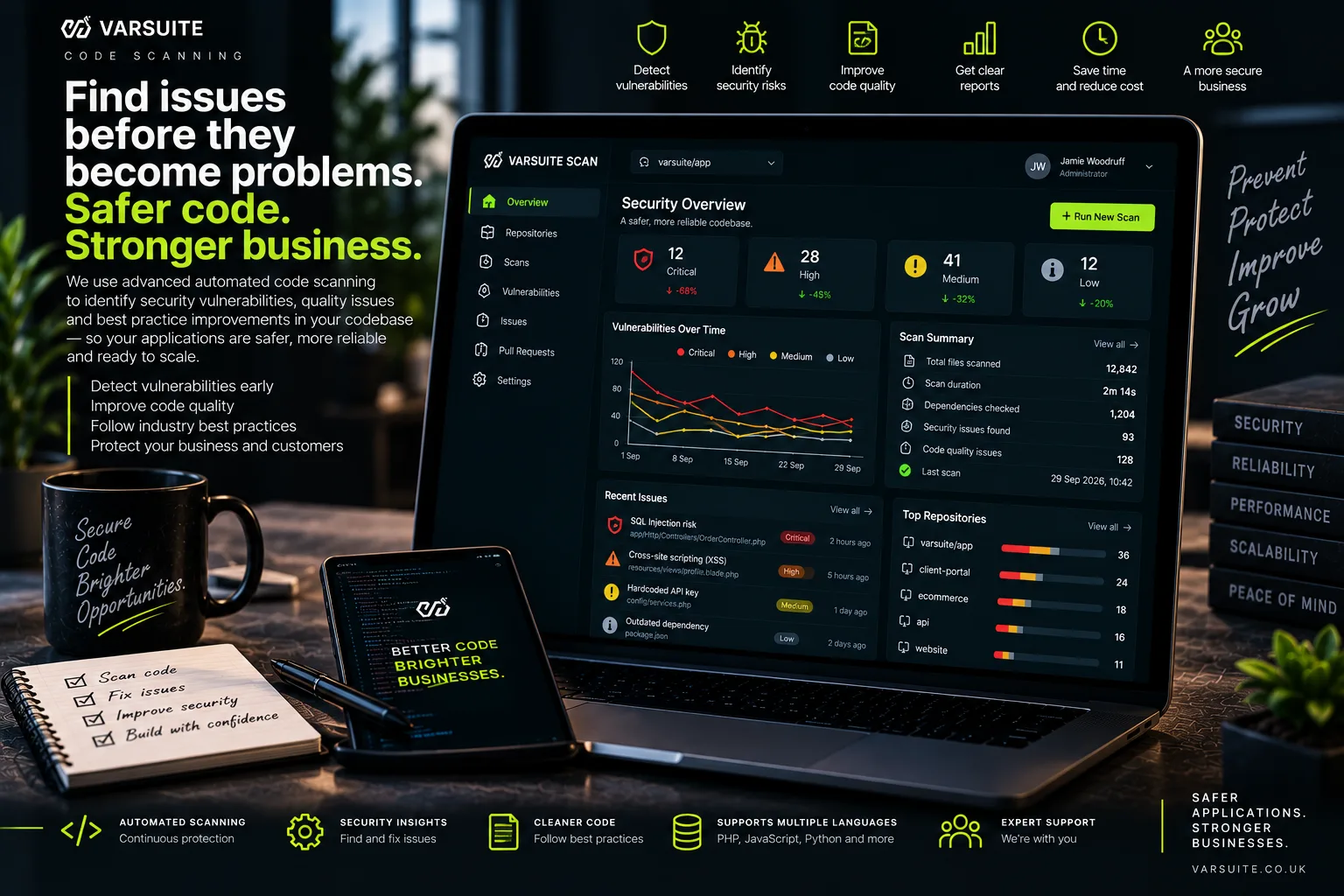
Varsuite scans every codebase for security holes, bad patterns and known vulnerabilities before it ships, then keeps scanning on a schedule afterwards so problems surface early, not after a breach.
What we build
- Websites
- E-commerce Stores
- Software Development
- Business Systems
- Mobile App Development
- Reward & Loyalty Apps
- Competition Websites
- Garmin App Development
- Wearable & Smartwatch Apps
- Progressive Web Apps
- AI Agents
- SaaS & MVP Development
- API Development
- Business Automation
- Booking & Scheduling Systems
- Process Replacement
- Custom CRM
- Customer & Member Portals
- Data Integrations
- Marketplace Platforms
- Subscription & Membership Sites
- Security Monitoring
- Testing & QA
- Accessibility Audits
- SEO & AIO Automation
- Social Media Management
- AI Content & Blogging
- AI Copywriting
- Google Ads Management
- Marketing Reporting
- Management
- Insight
- Always Improving
What is code scanning?
Code scanning is the automated inspection of your software's source code and its dependencies to find security holes, bad patterns and known vulnerabilities before they reach real users. It reads the code the way an attacker would, looking for the weaknesses that lead to data leaks, account takeovers and downtime.
Varsuite scans every codebase we touch at two points: before it ships, so nothing risky goes live, and on a regular schedule afterwards, because new vulnerabilities are discovered in libraries you already use.
AI agents run the scans quickly and a UK human team reviews what comes back, separating the real risks from the noise so you get a clear list of what actually matters.
What does a code scan look for?
A scan looks for the recurring categories of weakness that cause most real-world incidents, not just typos. The aim is to catch the issues that are easy to introduce and expensive to discover late.
Typical findings include:
- Injection flaws such as SQL injection and cross-site scripting
- Hard-coded passwords, API keys and secrets left in the code
- Known vulnerabilities in third-party libraries and packages
- Insecure authentication, sessions and access controls
- Bad patterns that quietly invite bugs and security gaps
- Out-of-date dependencies that no longer receive security fixes
We focus on findings you can act on. Every result our team forwards comes with what it is, why it matters and what to do about it.
Why scan on a schedule after launch?
Because code that was safe on launch day can become vulnerable later, even if nobody changes a line of it. New vulnerabilities are published constantly, and many sit inside the third-party libraries your software depends on.
A scheduled scan catches these as they emerge, so you hear about a serious dependency vulnerability from us rather than from an attacker or a customer. It is the difference between a quiet update and an emergency.
Scheduled scanning works hand in hand with our Security Monitoring service, which watches your live systems for active threats while code scanning keeps the underlying code clean.
How does Varsuite run a code scan?
We scan the codebase, our AI agents flag every potential issue, and a UK human team reviews the results before anything reaches you. You are never handed a raw, thousand-line report to interpret on your own.
First we point our tooling at your repository and dependencies and run a full scan. The AI sorts and prioritises what it finds, then our team checks each significant finding, removes false alarms and writes a plain explanation of the real risks.
Where a scan turns up a problem, we can fix it through our Software Development work, and our Testing & QA service adds functional and load testing so security and reliability are covered together.
Do you scan code you did not build?
Yes. We scan codebases we built, codebases inherited from a previous developer and software handed over without much documentation. You do not need to have built it with us to have it scanned.
Inherited code is often where the biggest surprises hide, because nobody currently working on it knows what shortcuts were taken. A scan gives you an honest picture of what you are actually running.
If the scan reveals deeper problems, we will tell you plainly and explain the options, from a focused fix to a structured improvement plan through our ongoing Management service.
How does pricing work for code scanning?
Your quote sets the payment stages and acceptance process. Recurring fees are billed in advance. You see the scan output and our review before you settle up.
For ongoing protection, scheduled scanning sits inside an affordable monthly care plan, so your code is re-checked regularly without you having to remember to ask. You can step in and out of care as it suits you.
We quote clearly before any work starts, so you know what the scan covers and what you are paying for.
Code Scanning, answered.
Code scanning is the automated inspection of software source code and its dependencies to find security holes, bad patterns and known vulnerabilities. It matters because most breaches exploit weaknesses that a scan would have caught, such as injection flaws, leaked secrets or out-of-date libraries. Varsuite scans every codebase before it ships and on a schedule afterwards, with a UK team reviewing the results.
Cost depends on the size of the codebase and how often you want it scanned, so we scope each job rather than quoting a flat figure. A £100 deposit secures most work and the balance is only due when you approve the finished result. Ongoing scheduled scanning is covered by an affordable monthly care plan.
Code should be scanned before every release and then on a regular schedule once it is live. Scanning before release stops risky code going out, and scheduled scanning catches new vulnerabilities discovered in your existing dependencies after launch. Varsuite builds both into how it ships and looks after software, so nothing is checked only once.
Yes. Varsuite scans codebases built by previous developers or handed over without documentation, not only the code we wrote ourselves. Inherited software is often where the biggest risks hide, so a scan gives you an honest picture of what you are running. If we find serious problems, we explain them plainly and lay out the options.
Code scanning inspects the source code and dependencies for weaknesses before and after release, while security monitoring watches your live systems for active threats and suspicious activity. One keeps the underlying code clean, the other keeps an eye on what is happening in production. Varsuite offers both, and they work best together.
No. Scans run quickly because AI agents do the heavy lifting, and the review stage is where a human focuses only on findings that genuinely matter. Catching a serious issue before release is far faster than dealing with it after a breach. The scan is designed to protect your timeline, not hold it up.
Explore related services
Security Monitoring
Varsuite watches what you have live around the clock and applies patches as threats appear, so vulnerabilities...
Learn moreTesting & QA
Every build is exercised by automated test agents and checked by a UK human before it reaches you, so faults a...
Learn moreSoftware Development
We build web apps, dashboards and internal tools, scaffolded and shipped with automated tests from day one. AI...
Learn moreManagement
Agents monitor, patch and update what they ship, with our UK team on hand, so your website, store and systems...
Learn moreFind the weak spots before anyone else does
Tell us about your codebase and we will scan it for security holes, bad patterns and known vulnerabilities. Your quote sets the scope, payment stages and acceptance process before work begins.