
Websites for care homes and home care providers
Varsuite builds websites, systems and careful automation for care providers across the UK, including a CQC-registered provider in Great Harwood. Clear, warm and trustworthy sites for the families choosing care, and practical software for the teams delivering it.
Families research care with more anxiety than any other purchase
Nobody browses for care the way they browse for a restaurant. The person on your website is usually a son, daughter or spouse making a decision they never wanted to make, often quickly, after a fall or a hospital discharge, and often carrying guilt about making it at all. They are simultaneously assessing you and reassuring themselves. A care provider's website has to work for a reader in that state: anxious, time-poor, unfamiliar with the system, and highly alert to anything that feels evasive or glossy.
Their research pattern is thorough. They will look up your CQC rating and read the report. They will compare two or three providers. They will try to work out what care actually costs and how funding works, questions most care websites conspicuously avoid. They will look for the humans: who runs this place, who would be looking after mum. And at some point they will want to talk to a person, which means the website's real job is to earn a phone call, not to close a sale. Increasingly they will also ask an AI assistant to explain their options, which makes plainly written, well-structured information about your services not just good manners but a visibility strategy.
Earning that call is about honest clarity, not marketing polish. Say plainly what care you provide and what you do not. Link to your CQC report rather than hoping nobody checks. Explain what happens after someone gets in touch, because the unknown next step is itself a source of dread. Show real people and real places, not stock photographs of hands on shoulders. We built the site for Highfield Services, a CQC-registered care provider in Great Harwood, on these principles, and they shape every care website we build. Families increasingly start with a search or an AI assistant question, so being findable and quotable matters too, which is where SEO and AIO automation comes in.
What a care provider's website must do
For the families it serves, a care website has a short and heavy list of duties.
- Explain services in plain English. Residential, nursing, dementia, domiciliary, respite: named clearly, described honestly, each on its own page so a family searching for a specific kind of care lands on an answer rather than a brochure.
- Put trust signals where they can be checked. Your CQC registration and rating, linked to the source. Who owns and manages the service. How long you have operated. Verifiable beats impressive.
- Address money without flinching. Fees and funding are the questions families are most anxious about and care websites most often dodge. Even an honest explanation of how funding routes work, and an invitation to discuss specifics, sets you apart.
- Make contact feel safe. A named person to ask for, a phone number, a form that promises a human response. Explain what happens next: a chat, a visit, an assessment, no obligation.
- Be accessible. Readable type, strong contrast, working keyboard navigation. Many visitors are older, and an inaccessible care website is a contradiction families will notice.
Underneath: fast pages, structured data so search engines and answer tools present your details correctly, and a design with warmth that does not tip into gloss. Every build is exercised by test agents and signed off by a person before it reaches you.
A brochure site is £500 plus £100 a month, with unlimited content and design changes within fair use, so staff changes, updated inspection outcomes and new photography are handled as routine rather than billed as projects. Details on the pricing page, and if you want the wider cost context, our guide to what a website costs in the UK is a straight read.
Location pages matter more in care than in most sectors, because care is chosen close to home. Families search for care in their own town, on behalf of a parent who lives in another, and a provider whose website plainly states the areas it serves, town by town, meets both searches. It is also worth writing for the professional audience: social workers, discharge teams and GPs recommend providers too, and they favour the ones whose websites let them check services and coverage in thirty seconds. None of this requires a bigger website, only a better-structured one.
Your website is also your best recruitment tool
Ask any registered manager what actually keeps them awake and the answer is rarely occupancy. It is staffing. Recruitment and retention are the defining operational problem in social care, and the provider website is a quietly decisive weapon in it, because every serious candidate looks you up before applying, and most application processes are dreadful enough to lose them.
Care workers job-hunt on their phones, often between shifts, often while employed somewhere that is burning them out. A careers section that works for that reader does a few specific things. It shows what working for you is actually like: real colleagues, real shifts patterns, real progression, not values statements. It states pay honestly, because vagueness reads as a warning. It lists current vacancies on pages of their own, so they can be found from a search for care jobs in your town. And above all it makes applying fast: a short form, a phone number, an invitation to an informal chat, not a demand for a CV and a covering letter at 11pm.
The follow-through matters as much as the form. Applicants who hear nothing for a week take another job; in care they take it within days. Our business automation work closes that gap: applications acknowledged immediately, the manager notified, reminders raised if nobody has responded, interviews confirmed without phone tag. Simple sequences, but they are the difference between a pipeline and a leaky bucket.
For providers recruiting at any scale, we can build the pipeline itself through our custom CRM work: one place where applications, interviews, references and onboarding checks live, visible at a glance, instead of scattered across an inbox. Recruitment is a system, and systems can be built. It is also worth saying that a strong careers presence feeds the family-facing site too: a provider that visibly invests in its staff is exactly what anxious families are looking for evidence of.
The paperwork behind care, and what software can remove
Care generates paperwork the way kitchens generate washing up: continuously, unavoidably, and it all has to be dealt with properly. Rotas, visit schedules, daily notes, audits, training matrices, incident reports, the spreadsheet that reconciles the other spreadsheets. Much of it exists for good regulatory reasons. But a great deal of the effort around it, the retyping, the chasing, the copying between systems, exists for no reason except that nobody has built anything better.
That is the work our business systems and process replacement services do: we look at how information actually moves through your organisation, find the places where humans are acting as glue between documents, and replace those places with software shaped to how you genuinely operate. Not a monolithic care platform you bend yourself around, but focused tools that remove specific weight: an enquiry log that actually tracks family conversations, a training matrix that flags expiries itself, an audit pack that assembles from records instead of being compiled at midnight before an inspection.
We build this kind of internal software as a core service, not a sideline. Insullite CRM, an internal CRM platform on our work page, shows the shape of it: bespoke, practical, built around one organisation's real workflow. Where you already run systems you are committed to, our data integrations work connects them so information is entered once, which in care is not merely efficient but safer, because retyping is where errors creep in.
Custom builds start from £1,000, scoped after we visit and see how you work. We are deliberate about scoping in care settings: the cost of software that does not fit how carers actually record and communicate is not wasted money but workarounds, and workarounds in care become risks. Better to build small, correct and adopted than large, impressive and ignored.
AI in a care setting, used responsibly
AI in care deserves more caution than AI in retail, and we practise what that implies. The opportunities are real: families ask the same important questions at all hours, staff spend care time on administration, and small providers cannot resource the steady communication that builds trust. But the setting is sensitive, the information is personal, and the tolerance for a wrong answer is low. So our starting position is that AI should handle the routine and the repetitive, and people should handle everything that touches judgement, wellbeing or distress.
In practice, a bespoke AI agent for a care provider handles the enquiries that have factual answers: what types of care you provide, your coverage area, visiting arrangements, what the next step is, what documents an assessment needs. It captures a family's details and situation carefully and hands the conversation to a named person, so the 11pm enquiry from a worried daughter gets a considered human response at 8am rather than a missed call log. It does not give care advice, and it is designed not to pretend otherwise.
The controls are concrete, not rhetorical. Automated features are off until you switch them on. Anything can be kept on manual review, so a person approves before anything is sent or published. Your portal includes an emergency stop that pauses agent activity. And the agent is trained on your organisation through a discovery process we record with your consent, so it answers as you, within boundaries you set.
The same philosophy runs through our content marketing for care, from £100 a month: AI content and blogging produces guides families genuinely search for, funding explained, how assessments work, choosing between home care and residential, and a person reviews everything before it publishes. Done steadily, that library becomes both your search visibility and a service to families in itself. AI agents start from £1,000 plus £150 a month per live agent; the pricing page has the full detail.
There is also an internal, quieter use of the same technology worth naming: agents that help your own team find information, look things up and draft routine correspondence for human review. Nothing public-facing, nothing autonomous, judgement always retained by people. For providers cautious about AI, and caution is the right instinct here, starting inside the organisation is often the most comfortable first step.
Proof, pricing and how the build works
The care sector runs on tight margins and tighter time, so both our pricing and our process are built to be undemanding. A £100 deposit secures your build. You tell us about your service, your registration and the families and candidates you need to reach; our AI agents produce the design and build while a UK team steers and checks every detail. You see a first preview within 72 hours. You review the finished site, and only when you approve it do the balance and hosting become due. Nothing goes live without your sign-off, which in a regulated sector is not a courtesy but a requirement, and it is how we work by default.
The numbers are published and flat: brochure websites from £500 plus £100 a month, custom systems and AI agents from £1,000 with agents at £150 a month per live agent, content marketing from £100 a month. The monthly website fee covers hosting, security monitoring and unlimited content and design changes within fair and reasonable use, which for a care provider means inspection outcomes, staff changes, new service pages and policy updates are simply maintained, not invoiced. Everything is on the pricing page.
Proof: Highfield Services, a CQC-registered care provider in Great Harwood, runs on a site we designed and built, and the rest of our work shows the same standard across other sectors, including the internal systems side that care providers increasingly need.
After launch, our management service keeps the site monitored around the clock with a real UK team behind it, and our security monitoring work watches what is live continuously, which matters when your website is part of how families and regulators perceive your governance. If your current site does not reflect the quality of your care, talk to us; we will give you an honest plan without a sales script.
Common questions
Brochure websites start at £500 plus £100 a month, which covers hosting, security monitoring and unlimited content and design changes within fair use, so inspection updates, staff changes and new service pages are maintained without extra fees. A £100 deposit secures the build, a first preview arrives within 72 hours, and you only pay the balance after approving the finished site.
Accessibility is a design requirement in every care build: readable type, strong contrast and pages that work across phones, tablets and desktops. Many of the people researching care are older themselves, and every build is exercised by test agents and signed off by a person before it reaches you.
Within careful limits, yes. A bespoke agent can answer factual questions about your services, coverage and next steps at any hour, capture a family's details and pass the conversation to a named person. It does not give care advice. Automation is opt-in, can be kept on manual review, and your portal includes an emergency stop. Agents start from £1,000 plus £150 a month per live agent.
Yes. We build custom CRMs and internal systems shaped to how your organisation actually works: recruitment pipelines, enquiry logs, training matrices, audit packs and integrations with the systems you already run. Custom builds start from £1,000 and are scoped after we visit and see your real workflow.
Work that backs this up
Real builds for real businesses in and around this industry, each one a published case study.
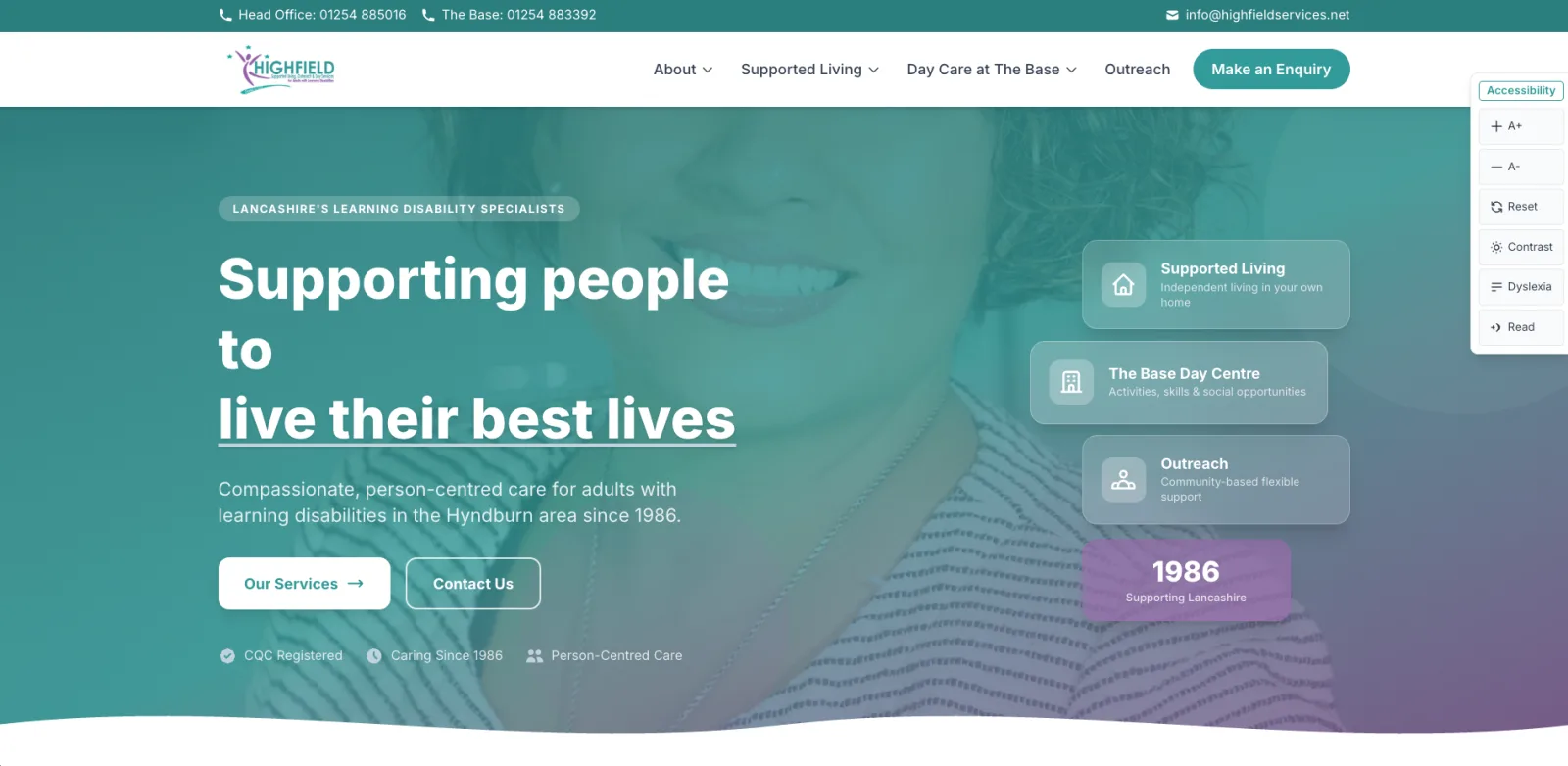
Highfield Services
CQC-registered learning disability care in Great Harwood and East Lancashire gets a warm new website with a built-in accessibility toolbar. Built for Highfield Services on Laravel, it gives supported living, day care and outreach their own space, and is made to be found by families searching for person-centred care across the Hyndburn area.
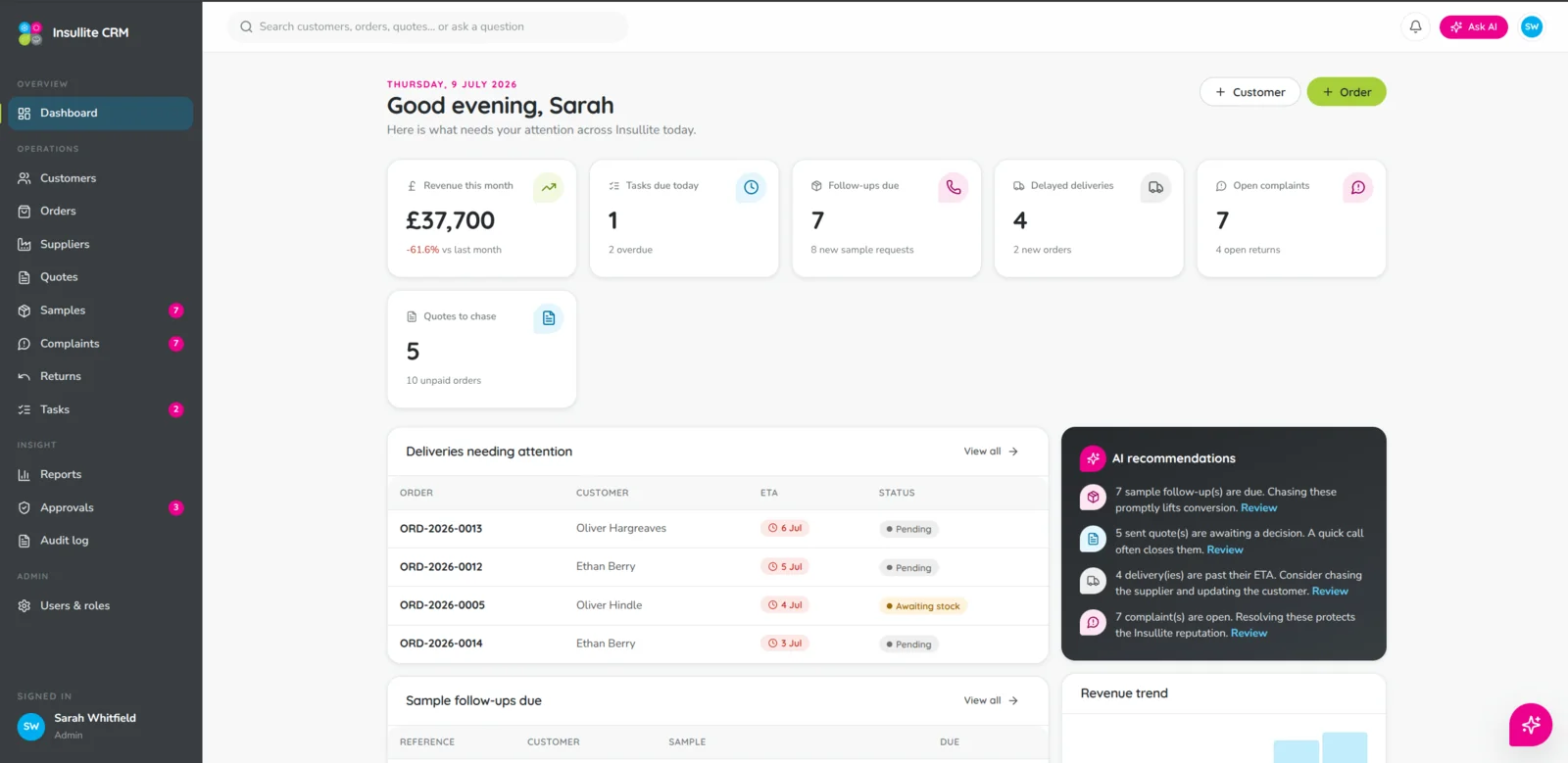
Insullite CRM
An internal operations platform for Insullite Ltd that pulls every brand, from Roofin to Buildin Stores to Plumin, and their back-office systems into one hub, with a permission-aware AI assistant that handles the busywork. Briefed, built and delivered in 24 hours.
Ready for a website worthy of your care?
A £100 deposit secures your build. First preview within 72 hours, and you only pay the balance once you have approved the finished site.