
APIs that connect everything and stay secure
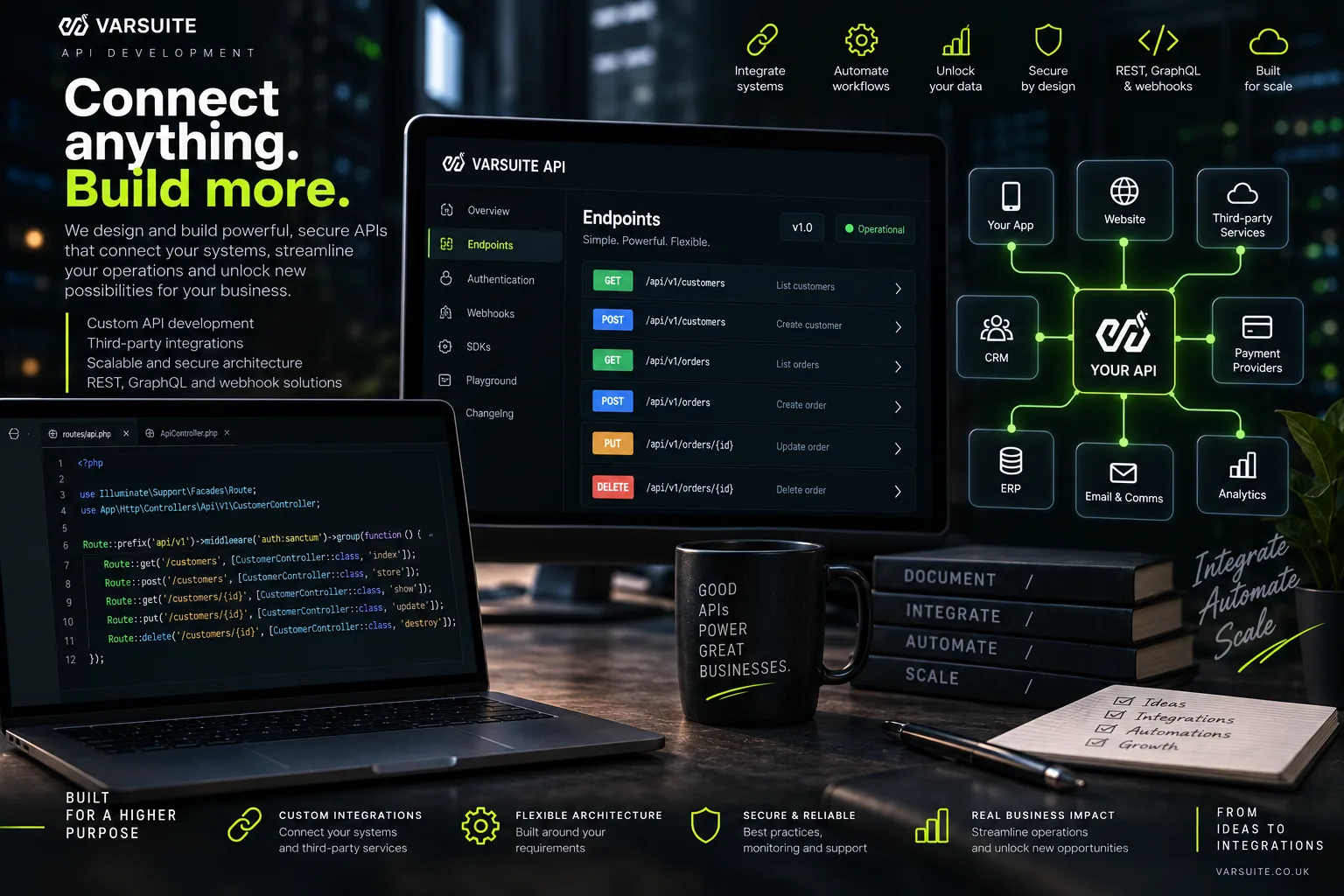
We design and build REST APIs and webhooks for mobile apps, partners and integrations, with authentication, rate limiting and clear documentation from the start. We build you a free working demo first, a live sandbox you can call before you commit, and it costs less than most people expect.
What we build
- Websites
- E-commerce Stores
- Software Development
- Business Systems
- Mobile App Development
- Reward & Loyalty Apps
- Competition Websites
- Garmin App Development
- Wearable & Smartwatch Apps
- Progressive Web Apps
- AI Agents
- SaaS & MVP Development
- Business Automation
- Booking & Scheduling Systems
- Process Replacement
- Custom CRM
- Customer & Member Portals
- Data Integrations
- Marketplace Platforms
- Subscription & Membership Sites
- Code Scanning
- Security Monitoring
- Testing & QA
- SEO & AIO Automation
- Social Media Management
- AI Content & Blogging
- AI Copywriting
- Google Ads Management
- Marketing Reporting
- Management
- Insight
- Always Improving
What does an API development company build?
An API development company builds the interfaces that let software talk to other software: the backend your mobile app calls, the endpoints partners use to send you orders, and the webhooks that tell other systems when something happens. Varsuite designs, builds, documents and looks after those APIs so they are secure, predictable and easy to integrate with.
Typical API projects include:
- Backends for mobile apps, including login, data sync and push notifications
- Partner and customer APIs so other businesses can integrate with your platform
- Integration APIs that connect your CRM, accounts, stock or booking systems
- Webhooks that notify other systems the moment orders, payments or bookings change
- Public or private APIs for a SaaS product
If you mainly need to connect existing tools rather than expose your own API, our data integrations service may be the better starting point.
What is the difference between a REST API and a webhook?
A REST API waits to be asked: another system sends a request and gets a response. A webhook works the other way round: your system sends a message to another system the moment something happens. Most good integrations use both.
How they compare:
- REST API. The client pulls data when it needs it, for example a mobile app loading a customer's orders. Predictable, easy to cache and easy to test, but the client has to keep asking if it wants to spot changes.
- Webhooks. Your platform pushes an event, such as order.paid, to a URL the partner provides. Near real time and efficient, but the receiver must be online, and delivery needs retries, signatures and logging to be dependable.
We build webhooks with signed payloads, automatic retries with backoff, a delivery log and a way to replay failed events, so a partner outage does not mean lost data. Where it genuinely suits the job we also consider GraphQL or real-time streams, but REST with webhooks covers most business needs well.
How do you secure an API?
We secure APIs with strong authentication, permission checks on every endpoint, rate limiting, input validation and logging, then test them the way an attacker would. Every API quote includes a penetration test and a security code review before launch.
The controls we build in:
- Authentication using API keys, OAuth 2.0 or signed tokens, depending on who is calling
- Authorisation checked on every request, so one customer can never read another's data
- Rate limiting per key or user, to protect the service from abuse and runaway scripts
- Validation of every input, with clear error messages that do not leak internals
- Audit logs and monitoring, so unusual activity is spotted and can be traced
- HTTPS everywhere, with secrets stored encrypted and keys that can be rotated
For protection after launch, our security monitoring service watches for threats and new vulnerabilities.
How do you document and version an API?
We document every API with an OpenAPI specification and readable reference pages, and we version it from the first release so changes never break the apps and partners that depend on it. Good documentation makes an API quick to integrate with, and good versioning keeps it trustworthy.
In practice that means:
- An OpenAPI (Swagger) specification kept in step with the code, so the docs match what the API really does
- Example requests and responses for every endpoint, plus a sandbox to try them
- A version in the URL or header, such as /v1, with breaking changes only in a new version
- A published deprecation policy and changelog, so partners get notice before anything is retired
- Automated contract tests that fail the build if a change would break existing clients
Can we try the API before we commit?
Yes. We build you a free working demo first: a live sandbox API with real endpoints, sample data and documentation, so your developers or partners can call it before you commit to anything. Going from that sandbox to a production API costs less than most people expect.
The demo usually covers the part that matters most, such as a partner placing an order or a mobile app loading an account, with a webhook firing back. If it proves the approach, we agree a fixed quote before any paid work starts. Our pricing page explains how quotes work.
How are your APIs built, tested and looked after?
AI agents do the heavy lifting on the build, and a UK human team based in Lancashire reviews, perfects and signs off every release. Automated tests run from day one, covering each endpoint, permission rule and webhook, so the API proves it still works every time it changes.
After launch, ongoing monthly care covers updates, dependency and security patches, monitoring, and new endpoints as your partners' needs grow. We can add load testing and deeper checks through our testing and QA service. You own the API and its code, and we are happy to hand over access and explain how everything works.
API Development, answered.
It depends on the number of endpoints, the systems the API connects to and the security and documentation required, so we quote each project rather than publishing a flat figure. Varsuite builds a free working demo sandbox first, then agrees a fixed quote before work starts. Most clients find it costs less than they expected.
An API responds when another system asks it for data, while a webhook sends data to another system as soon as something happens. APIs suit on-demand requests, and webhooks suit real-time notifications. Varsuite usually builds both, with retries and signatures so webhook deliveries are dependable.
Varsuite combines authentication, per-key rate limiting, input validation and monitoring so misuse is blocked or spotted quickly. Every API quote includes a penetration test and a security code review before launch. Keys can be revoked and rotated without taking the service down.
Yes. Varsuite builds backends for iPhone, Android and wearable apps, covering login, data sync, push notifications and anything else the app needs. The same API can later serve a web app or partners, so you are not building the logic twice.
Yes. Every API comes with an OpenAPI specification, reference pages with example requests and responses, and a sandbox to try them. Varsuite keeps the documentation in step with the code, so partners are not caught out by out-of-date docs.
Often, yes. If your existing system has a sensible database and structure, Varsuite can build an API alongside it so partners and apps can connect safely without rebuilding everything. We review what you have first and tell you honestly whether an API layer or a wider rebuild makes more sense.
Yes, because AI is not the last line of defence. AI agents do the heavy lifting, and a UK human team reviews, perfects and signs off every release, backed by automated tests from day one. Every API quote also includes a penetration test and a security code review before launch.
Explore related services
Data Integrations
Varsuite data integrations connect the tools you already use so your data stays in sync automatically, with no...
Learn moreMobile App Development
We build native and cross-platform apps for iPhone and Android, and we start with a free working demo you can...
Learn moreSaaS & MVP Development
We turn software ideas into working products: a focused MVP to test with real users, then a multi-tenant SaaS...
Learn moreCode Scanning
Varsuite scans every codebase for security holes, bad patterns and known vulnerabilities before it ships, then...
Learn moreCall your new API before you commit
Tell us what needs to connect and we will build a free working demo sandbox with real endpoints and docs. It costs less than most people expect, and a fixed quote is agreed before any paid work starts.