
One app that installs from the browser
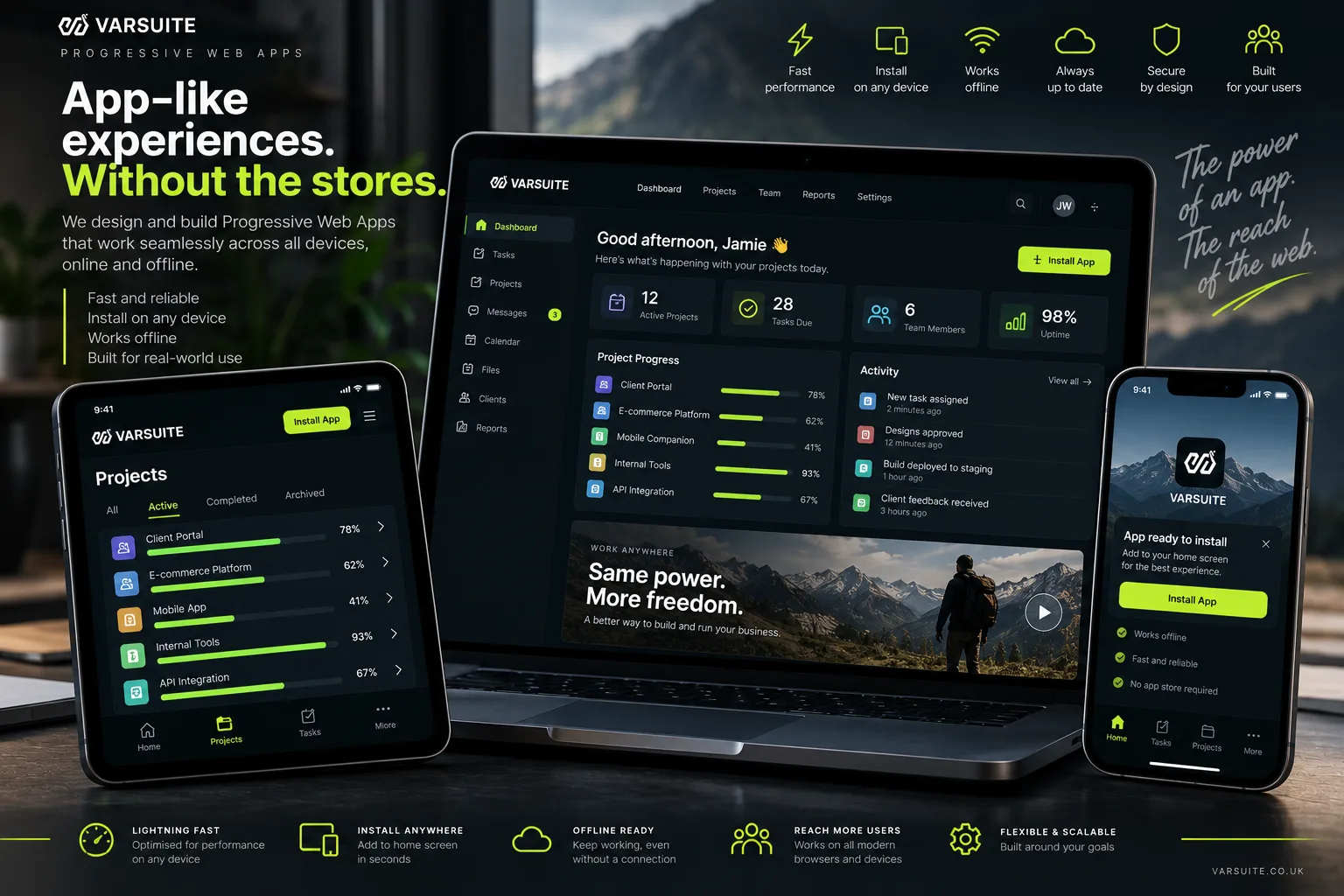
A progressive web app installs to the home screen, works offline and can send push notifications, all from one codebase that runs in the browser. We build you a free working demo first, so you can install it on your own phone before you commit, and it costs less than most people expect.
What we build
- Websites
- E-commerce Stores
- Software Development
- Business Systems
- Mobile App Development
- Reward & Loyalty Apps
- Competition Websites
- Garmin App Development
- Wearable & Smartwatch Apps
- AI Agents
- SaaS & MVP Development
- API Development
- Business Automation
- Booking & Scheduling Systems
- Process Replacement
- Custom CRM
- Customer & Member Portals
- Data Integrations
- Marketplace Platforms
- Subscription & Membership Sites
- Code Scanning
- Security Monitoring
- Testing & QA
- SEO & AIO Automation
- Social Media Management
- AI Content & Blogging
- AI Copywriting
- Google Ads Management
- Marketing Reporting
- Management
- Insight
- Always Improving
What is a progressive web app?
A progressive web app (PWA) is a website built to behave like an installed app: it can be added to the home screen, open in its own window without browser bars, work offline and send push notifications. It is still one web codebase, served from your own domain and updated the moment you deploy.
The pieces that make a PWA work are:
- A web app manifest, which gives the app its name, icon, colours and app-style display
- A service worker, a small script that caches files and data so the app loads fast and keeps working without a signal
- HTTPS, which browsers require before they allow installation, offline caching or notifications
- A responsive design that feels natural on phones, tablets and desktops
PWAs suit booking tools, customer portals, field staff apps, ordering and loyalty apps, and internal tools where the priority is reaching people quickly on any device.
Should I build a PWA or a native app?
Choose a PWA when reach, speed and a single codebase matter most, and choose a native app when you need deep device features, the smoothest performance or a listing in the App Store. Many businesses start with a PWA and add native apps later if usage justifies it.
Where a PWA wins:
- One codebase for Android, iPhone, tablet and desktop
- No app store review, so updates go live as soon as they are deployed
- Found through search and shared with a simple link
- Usually quicker and less costly to build and maintain
Where a native app wins:
- A listing in the App Store and Google Play, where some customers expect to find you
- Deeper access to hardware such as Bluetooth, NFC, health data and background tasks
- Smoother performance for heavy graphics, games or complex animation
- More dependable push notifications and background behaviour on iPhone
If a native app sounds like the better fit, our mobile app development service covers iPhone and Android. We will tell you honestly which route suits your project when we scope it.
Do progressive web apps work on iPhone?
Yes, but with real limitations on iPhone and iPad that you should understand before choosing a PWA. Safari supports installable web apps, offline caching and (since iOS 16.4) push notifications, but Apple has not matched everything Android and desktop browsers offer.
The main iOS limitations today:
- No automatic install prompt. Users add the app from the Share menu, so we design a short in-app guide that walks them through it.
- Push notifications only after installing. On iPhone a PWA can only send notifications once it has been added to the Home Screen and the user has allowed them.
- Limited background work. Background sync and periodic updates are not available, so the app refreshes when it is opened.
- Missing hardware access. Web Bluetooth, Web NFC and some sensor features are not supported.
- Stored data can be cleared. iOS may remove saved data, for example when the device is short of space, so we treat offline storage as a cache and keep the real data safely on the server.
On Android, and in Chrome and Edge on desktop, PWAs are much closer to native apps, with install prompts and more background features. Apple changes its web support over time, so we check the current position when we scope your project.
How does a PWA work offline?
A PWA works offline by using a service worker to save the app's screens, files and recent data on the device, then serving them from that cache when there is no connection. When the signal returns, the app refreshes its data and sends any queued changes to the server.
We choose a caching approach for each part of the app:
- App shell cached first, so the interface opens instantly even on a poor connection
- Content refreshed in the background, so people see the last known version straight away and the newest version shortly after
- Forms and actions queued, so a job note or order made with no signal is not lost
- Clear offline indicators, so users always know whether they are looking at live or saved data
Offline support is where PWAs earn their keep for field staff, events, and anywhere in rural Lancashire or beyond where mobile coverage is patchy.
Can we try a PWA before we commit?
Yes. We build you a free working demo first, and because it is a PWA you can install it on your own phone from a link and use it like a real app before you commit to anything. Turning that demo into a finished product costs less than most people expect.
The demo covers the core screens and journey, with install and offline behaviour switched on, so you can test it in the places your users will actually be. If it is right for you, we agree a fixed quote before any paid work starts. Our pricing page explains how that works.
How is a PWA built, secured and looked after?
AI agents do the heavy lifting on the build, and a UK human team reviews, perfects and signs off every release. Automated tests run from day one, including checks that the app installs, caches and recovers from going offline as expected.
Every app quote includes a penetration test and a security code review before launch. Because a PWA lives on the web, it also shares the hosting, monitoring and HTTPS setup we use for our websites.
There is no app store review to wait for, so fixes and features reach users as soon as we deploy them. If you later want a Google Play listing, a PWA can often be packaged for it, while an App Store listing usually needs a native or cross-platform build. Ongoing monthly care keeps the app updated as browsers change, and you own what we build.
Progressive Web Apps, answered.
A PWA is a website with app features added: it can be installed to the home screen, open in its own window, work offline and send push notifications. A normal website needs a connection and lives only in a browser tab. Varsuite builds PWAs so people get an app experience without visiting an app store.
Usually, because one codebase serves every device and there are no separate iPhone and Android builds to maintain. Varsuite builds a free working demo first and then agrees a fixed quote before work starts, so you know where you stand. Our pricing page explains how quotes are put together.
Yes, since iOS 16.4, but only after the user has added the app to their Home Screen and allowed notifications. Android and desktop browsers are more flexible. Varsuite designs the install and permission steps so iPhone users can switch notifications on easily.
A PWA can often be packaged for Google Play, but Apple generally expects App Store apps to offer more than a wrapped website. If an App Store listing matters to you, Varsuite will recommend a native or cross-platform app instead. We are clear about this when we scope your project.
Yes. A service worker saves the app's screens and recent data on the device, so it opens and shows saved content without a connection. Varsuite designs offline behaviour for each screen, including queuing changes so they are sent when the signal returns.
Often, yes. If your site is already responsive and served over HTTPS, we can add a manifest, a service worker and offline handling, then improve the parts that need to feel more like an app. Varsuite reviews the site first and tells you whether upgrading it or building fresh is the better route.
Yes, when they are built properly. PWAs must run over HTTPS, and Varsuite adds authentication, permission checks and careful handling of anything cached on the device. Every app quote includes a penetration test and a security code review before launch.
Explore related services
Mobile App Development
We build native and cross-platform apps for iPhone and Android, and we start with a free working demo you can...
Learn moreSoftware Development
We build web apps, dashboards and internal tools, scaffolded and shipped with automated tests from day one. AI...
Learn moreCustomer & Member Portals
We build secure customer and member portals where people log in to see their documents, orders, invoices and s...
Learn moreSaaS & MVP Development
We turn software ideas into working products: a focused MVP to test with real users, then a multi-tenant SaaS...
Learn moreInstall your app from a link, before you commit
Tell us what your app needs to do and we will build a free working demo you can install on your own phone. It costs less than most people expect, and a fixed quote is agreed before any paid work starts.