
Lafeef
Lafeef, a luxury furniture and decor rental house in Riyadh, gets a bilingual English and Arabic site over a catalogue of more than 1,100 pieces. Piece counts, specifications and a quote basket in place of a checkout, built for the event planners working across Saudi Arabia and the Gulf.
The challenge: a rental catalogue of more than a thousand pieces, for planners working in two languages
Lafeef is a luxury furniture and decor rental house based in Riyadh, Saudi Arabia, serving clients across the Kingdom and arranging deliveries for projects in the United Arab Emirates, Qatar and Kuwait. The company dresses weddings and galas, exhibitions and conferences, and retail and hospitality spaces, working alongside the wedding planners, event organisers and interior designers who choose the pieces.
The inventory is the business. More than a thousand individual pieces, from accent chairs and bridal sofas through to charger plates and napkin rings, each held in a finite quantity that a planner needs to know about before they commit to a room. None of it is sold off a shelf. A rental is quoted, scheduled, delivered, set up and collected, with a deposit, a lead time and a cancellation window attached to it.
The brief was never a shop. It was to make a working rental catalogue browsable, to show what Lafeef actually holds, to meet an audience that works in Arabic as much as in English, and to turn a browse into a qualified quote request.
What we built: a bilingual site with a quote basket in place of a checkout
We designed and built Lafeef a brand-new website on Laravel, built around their identity: a single warm sand field running from the navigation through to the footer, deep burgundy and olive accents, and a bilingual wordmark that draws the Latin and the Arabic letterforms in the same hand. Photography does the selling, and the interface stays out of its way.
- A parallel Arabic site, not a translation widget. The Arabic build runs right to left on its own set of URLs, with translated navigation, pages and project write-ups. A planner in Riyadh gets a site laid out for their language, not an English one with the words swapped over.
- The whole inventory, browsable. More than 1,100 pieces across more than thirty categories, grouped into seating, tables and accessories, each with its own page, its own address and a rail of related pieces. The grid loads twenty at a time as you scroll, so a planner works down a category in one continuous run instead of clicking through numbered pages.
- Every piece shows how many Lafeef holds. A piece count sits on every product page, alongside the reference code, the photo gallery and its description, colour, material and dimension tabs. Someone furnishing for six hundred guests can see whether the quantity exists at all, then have their dates confirmed on the quote.
- A cart that ends in a quote, not a payment. Rental pricing turns on dates, duration and location, so the basket sets out the sub-total, the security deposit and the tax, then submits a quote request rather than taking payment. The team comes back with an initial quote within two working days.
- Accounts and a saved wishlist. Customers register, sign in and keep a wishlist of pieces across visits, which matters when a single event gets specified over weeks rather than in one sitting.
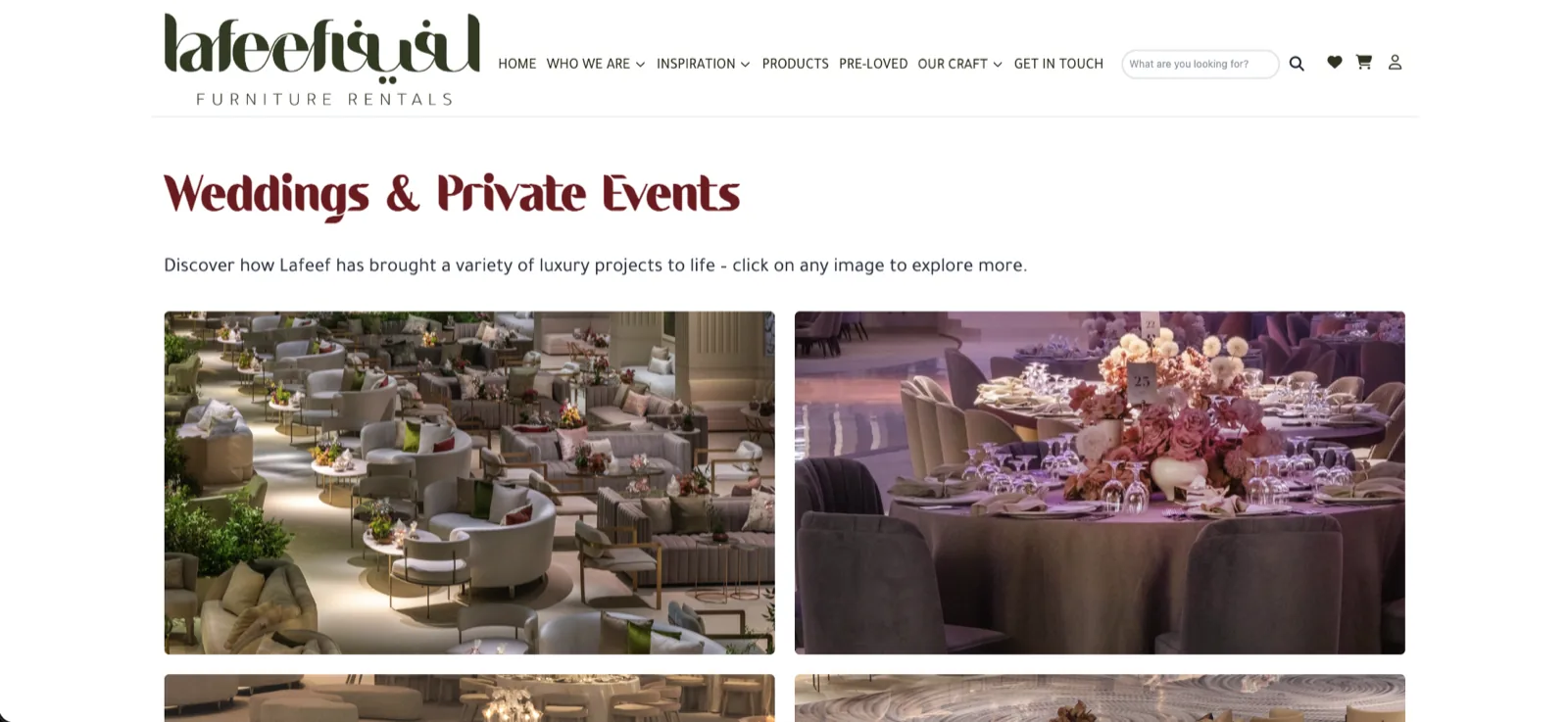
- The portfolio, event by event. Twenty-four completed events across four galleries, each opening into an image slider and the details a planner judges work on: the palette, the furniture style, the setup, the guest count and the city, from an intimate dinner in Jeddah to a government banquet for fifteen hundred guests in Riyadh.
- Every way to make contact, in one place. A contact form whose country and dialling-code pickers put the Gulf markets first, click-to-call, WhatsApp, email and a newsletter sign-up. Paid traffic gets its own landing page, with a form that asks for company, industry and job title, so an enquiry arrives already qualified.
Built to be found by category and by piece
A rental catalogue is only worth anything if the individual pieces are reachable. Every category sits at a word-based address of its own rather than behind a filter, and every piece has a permanent, linkable page, which puts more than 1,100 product pages and every category page into an XML sitemap listing close to 1,200 addresses in total. Each event sector gets a page of its own rather than sharing one catch-all. It means the searches that matter to a rental house, a category like bridal sofas or charger plates, or an event type in Riyadh or Jeddah, land on Lafeef's own page for it, and a planner can send a colleague straight to the exact chair.
Common questions about the Lafeef website
Can you order furniture directly on the site?
No. Rental pricing depends on dates, duration and location, so the site works as a quote basket. A planner adds pieces to the cart and submits a quote request, and the Lafeef team replies with an initial quote within two working days.
Does the site show how much of a piece Lafeef holds?
Yes. Every product page carries a piece count alongside its reference code and its specification tabs, so a planner specifying for hundreds of guests can see whether the quantity exists at all. Availability for their particular dates is then confirmed on the quote.
Is the site available in Arabic?
Yes. There is a full Arabic build on its own set of URLs, laid out right to left, with translated navigation, pages and project write-ups, which matters for a Riyadh business whose clients and partners work across both languages.
A bilingual site over a rental catalogue of more than a thousand pieces, showing the quantities Lafeef holds and turning a browse into a qualified quote request for planners across Saudi Arabia and the Gulf.
The result: a rental catalogue that works the way the business does
Lafeef now has a website that matches the inventory: deep, exact and addressable. The full catalogue is browsable, every piece carries its quantity and its specification, and the basket gathers a qualified quote request instead of pretending to be a checkout. The portfolio shows the range of the work, from private dinners to state occasions, and the site reads in Arabic as readily as in English. A rental operation that lives on quantities, dates and deposits finally has a catalogue that respects all three.
Want results like these?
Tell us what's slowing you down. We'll show you a finished preview before you pay anything.