
More Polythene
More Polythene, a family-run polythene manufacturer in Blackburn, gets a Laravel site built for the way its customers actually search. Nineteen product pages, six technical guides, four working calculators and 89 UK delivery areas, wired into one machine-readable surface so the answers are quotable by search engines and AI alike.
Visit More Polythene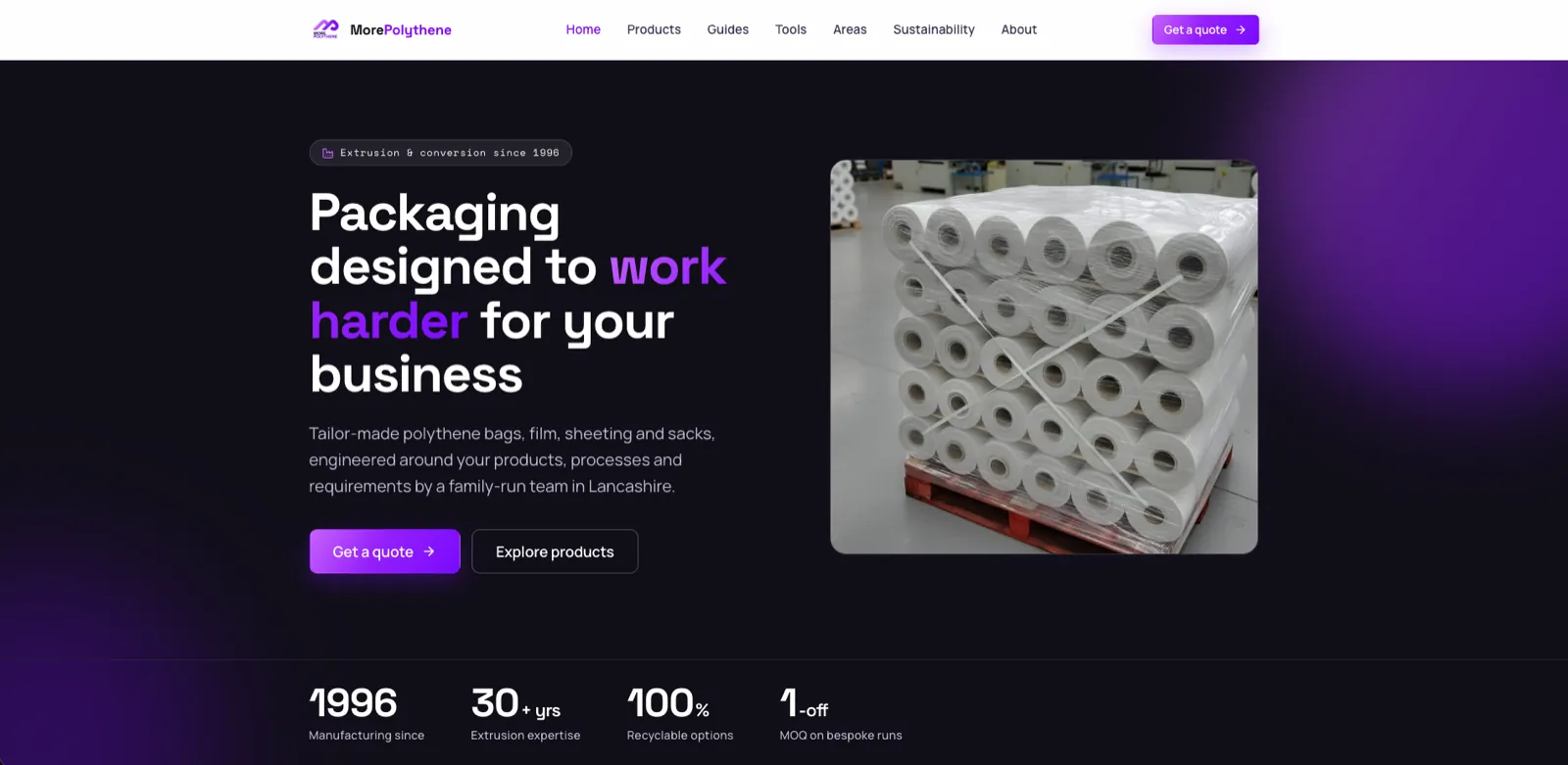
The challenge: a technical range that nobody searches for by name
More Polythene has extruded and converted polythene at Griffin Mill in Blackburn since 1996. It is family-run, everything is made on site, and there are no premises anywhere else. The range runs from mailing bags and refuse sacks through shrink film, layflat tubing, anti-static film, pallet covers and sheeting, out to whatever a customer specifies, cut to their size and gauge in runs from a single one-off to bulk.
The difficulty with a business like that is that almost nothing it sells is a shelf product, and almost nobody searches for it by name. A buyer with a job to do searches for the job: what gauge do I need for a mailing bag, is shrink film or stretch wrap right for my pallets, how many microns is 400 gauge, who supplies polythene in Cheshire. Those are a dozen different questions with a dozen different answers, and a brochure site with one products page cannot answer any of them properly.
There was a second problem stacked on top of the first. More and more of those questions now get answered before anyone reaches a website at all, by a search engine's own summary or by an AI assistant. If the answer is not on a page of its own, written plainly and marked up so a machine can read it, the manufacturer who actually knows the answer never gets the credit for it.
The brief was to turn what More Polythene knows into pages that can be found, read and quoted.
What we built: a site shaped like the questions
We designed and built the site from scratch on Laravel, working from the brand kit the client supplied and turning it into a proper design system rather than a set of one-off screens. Then we spent most of the effort on the thing that actually matters here, which is the content architecture underneath it.
- A product page per product, not a catalogue entry. All nineteen products get a full page of their own: an intro, the key points, a seven-row specification table, four sections of prose under plain-English question headings, the applications the product is actually used for, its own FAQs and links to the three products a buyer most often compares it with. That is around a thousand words per product, and every one of the 76 section headings across the catalogue is written for that product rather than reused.
- A catalogue that filters without JavaScript. The seven category filters on the products hub are ordinary links, handled on the server. The page works with scripting switched off, and a filtered view points back at the hub rather than competing with it in search.
- Six long-form technical guides. Roughly two thousand words each on the questions that come up before a specification exists: choosing a bag, understanding micron against gauge against mil, recycled compared with biodegradable, shrink against stretch against pallet covers, layflat tubing, and how to use less film without losing protection. Each carries a short answer at the top, a comparison table, five questions and answers, and links through to the products it covers.
- Four calculators that do real work. A thickness converter that moves between micron, gauge, millimetres and mil. A bag size finder that turns product dimensions into a finished bag size and a suggested gauge. A pallet shrink-wrap calculator that estimates film metres and rolls. A product selector that turns three questions into a recommendation. They run in the browser, and each one hands its result straight to the quote form with the specification already filled in.
- 89 delivery-area pages, written rather than spun. Each UK county and city gets its own page with its own introduction, its own named towns and industries, and its own first question and answer, all anchored to the fact that the manufacturing happens in Blackburn. The template around them is shared, which is the honest way to do this, but the part that says anything about the area is written for that area.
- A quote form that already knows what you want. Nine fields, and the product, specification or delivery area carries through from wherever the visitor came from, so somebody arriving from the bag size finder sees their own dimensions already in the box. Submissions are validated on the server, protected by a hidden honeypot and a rate limit, and the confirmation page cannot be reloaded or linked to.
Built to be read by machines as well as people
This is the part of the build we would point at first. Every page carries structured data describing what it is, all of it referring back to a single canonical description of the business rather than each page inventing its own. Products are marked up as products, guides as articles, area pages as services, tools as applications, and the questions and answers on 118 of the pages are marked up as questions and answers, 486 pairs in total.
The machine-readable files are generated from the live content rather than maintained by hand, so they cannot drift out of step with what is actually published: the XML sitemap, the robots file, and an llms.txt that gives an AI assistant a plain, link-first map of the site with each page's real description attached. Publishing works the same way throughout. A page exists when its content file exists, and that single fact adds it to its hub, the sitemap and the machine-readable index at the same moment.
We also made the build refuse to lie. Automated tests fail the build if a page starts claiming a certification the company does not hold, and the identifiers we could not verify, from the company number to a review score, are left out rather than invented. Further tests hold the editorial line: one heading per page, introductions within a set length, meta descriptions that fit, and every internal cross-reference resolving to a page that really exists.
Common questions about the More Polythene website
Why build 89 area pages instead of one delivery page?
Because a buyer in Cornwall and a buyer in Aberdeenshire are asking different questions, and a single page cannot rank for or honestly answer both. Each area page names the towns and industries in that area and gives the real delivery expectation for it. What it never does is pretend to a local presence that does not exist, since everything is made in Blackburn and the copy says so.
What is llms.txt and why does the site have one?
It is a plain text map of a site written for AI assistants rather than browsers, so a model answering a question about polythene can find the right page and read an accurate summary of it. Ours is generated from the live content, so it lists every product, guide and tool with that page's own description and cannot fall out of date.
Do the calculators need an account or a developer to maintain?
Neither. They run entirely in the visitor's browser, there is nothing to log in to, and the product selector reads the live catalogue, so adding a product to the site adds it to the tool.
A manufacturer's expertise turned into 126 pages that answer the question, prove the specification and hand the visitor to a quote form that already knows what they need.
The result: the range, finally addressable
More Polythene now has a website the shape of its own business. Every product has an address, a specification and an answer to the four questions buyers actually ask about it. The technical knowledge that used to live in a sales conversation is published, structured and quotable. The calculators do a job for someone who has not made contact yet, and then pass them to the quote form with their own numbers already in it. And because the sitemap, the robots file and the machine-readable index are all generated from the content itself, the site describes itself accurately to search engines and AI assistants without anybody remembering to update a file.
Want results like these?
Tell us what's slowing you down. We'll show you a finished preview before you pay anything.