
Signature Alloy Wheel & Body Repairs
A Radcliffe body shop and mobile repair fleet, rebuilt off an ageing WordPress site onto a Laravel build of 276 pages. Every one of the 156 local area pages is written for its own place, and all 245 addresses the old site published in its page and article sitemaps stay exactly where they were.
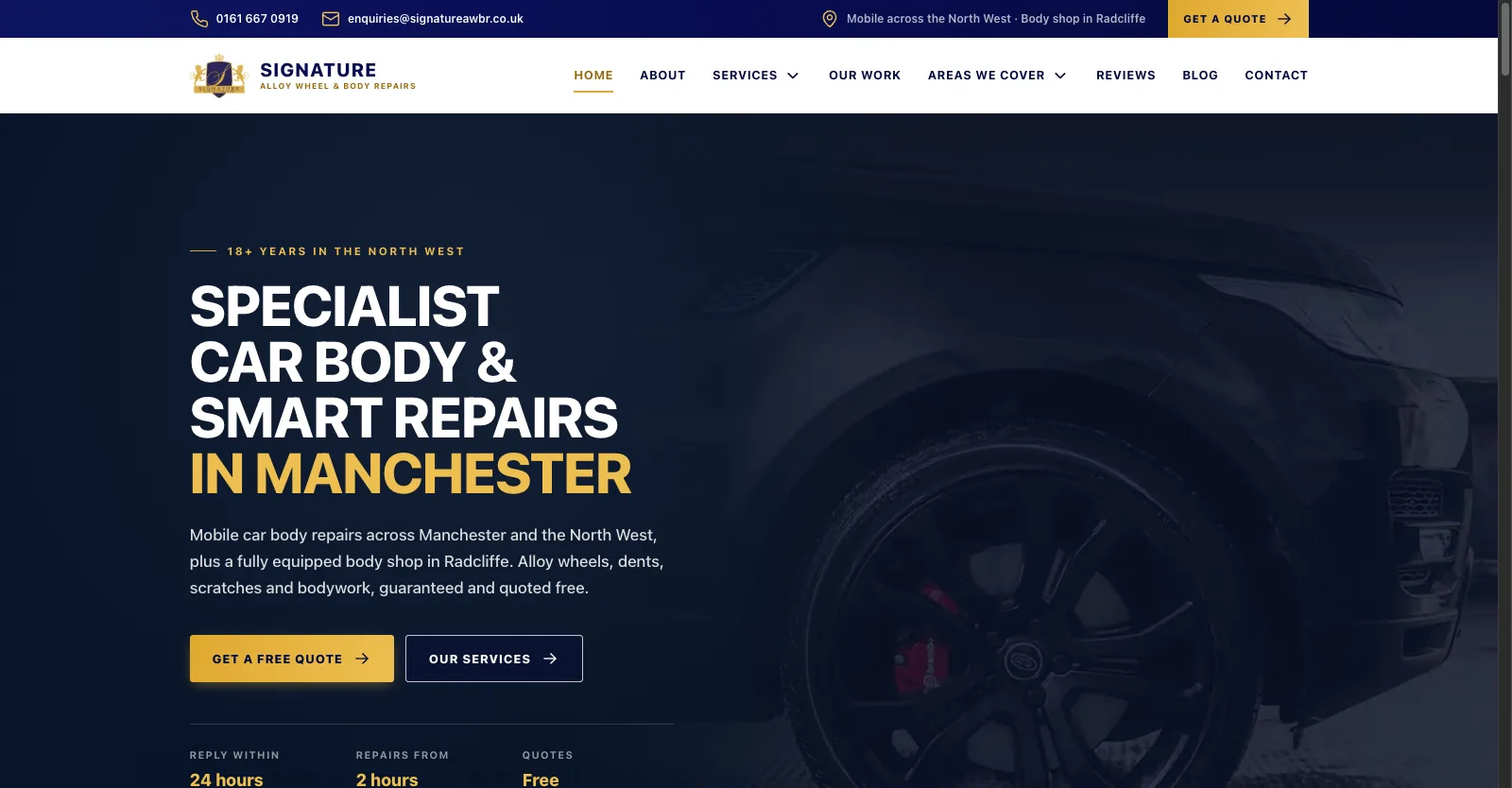
The challenge: a body shop's search coverage trapped on an ageing WordPress site
Signature Alloy Wheel & Body Repairs is an alloy wheel refurbishment and car body repair business in Radcliffe, Greater Manchester, trading since 2008 and running a mobile SMART repair fleet alongside its own body shop. Varsuite designed and built Signature a new website on Laravel: 276 pages, 156 of them local area pages written one place at a time, and all 245 addresses the old site published in its page and article sitemaps kept exactly where they were.
The old WordPress site had built up real coverage. It publishes 268 URLs across five sitemaps, 167 of them selling pages, most of those targeting one repair type in one named place. It had also stopped moving. Its newest sitemap entry is dated April 2024, and its about page still reads "Over 16 years experience", a number typed in by hand when it was true and quietly wrong ever since.
Rebuilding out of that position is awkward, because the coverage is real and a new site that tidies up the old addresses throws it away. The old build is heavy as well. Its homepage sends 163 KB of HTML before a single photograph loads, across 42 script tags and 19 stylesheets, and nothing in its structured data tells a search engine that Signature has a business address, opening hours or a service area.
So the brief was to keep every address the old site had earned, replace template filler with copy genuinely about each place, and describe the business precisely enough that a search engine or an AI assistant can answer a question about it without guessing.
What we built: a 276 page website for a body shop and alloy wheel refurbisher
The new Signature Alloy Wheel & Body Repairs website is a Laravel build of 276 pages: 13 core pages, 11 service pages, 28 location hubs, 156 service area pages and 68 advice articles. All 276 are requested by the automated test suite on every run and checked that they load, so a broken page cannot reach a customer.
- Eleven service pages, each a document in its own right. Mobile SMART repairs, alloy wheel refurbishment, diamond-cut wheel repair, body repairs, dents, scuffs and scratches, bumpers, stone chips, lease cars, specialist vehicles and machine polishing. The eleven run to 23,066 words between them and carry 87 questions and answers, every section heading phrased as a question a customer would actually type.
- 156 service area pages, written one at a time. Seven repair types across 28 places, 158,530 words in total. Each pairing holds its own file with its own heading, opening answer, introduction, sections, local detail and questions, rather than drawing them from a shared template.
- 28 location hubs carrying measured geography. Every place has its postcodes, its distance from the body shop, a drive time, coordinates, landmarks and its neighbouring places: 181 postcode areas and 112 named districts and landmarks across a spread of 3 to 47 miles from Radcliffe. The distance and the drive time sit under the hero, ahead of any marketing copy, because that is the first thing a customer wants to know.
- 68 advice articles kept at their original addresses. Every post the old site published is here, unmoved, at 151,142 words carrying 325 questions and answers.
- A machine-readable description of the business on every page. One structured data graph per page rather than scattered snippets, so the business, the site, the page and the service relate to one another explicitly. An area page's graph names eight schema types across six linked nodes, and the business node carries the address, phone, email, opening hours, coordinates, a service radius of roughly 50 miles, a catalogue of all eleven services and each of the 28 areas served by name. Across the site that comes to 1,178 question and answer pairs published as structured data, and 266 of the 276 pages open with a self-contained answer written to survive being quoted on its own. That is the SEO and AIO automation layer: it gives a search engine or an AI assistant Signature's real details to quote instead of leaving it to guess.
- A front end that weighs almost nothing. Against the old homepage's 42 script tags and 19 stylesheets, the new build's interactive JavaScript is 73 lines compiled to a single 1,451 byte bundle, with no client-side framework and the fonts served from the site itself. Its 382 photographs each carry responsive variants, generated only up to a picture's own width so nothing is ever upscaled. Someone who has just kerbed an alloy is standing next to the car on a phone, so the number is a tap-to-call link five times over on every page.
- A quote form that will not lose a lead to a mail outage. The enquiry is written to the database before any email is attempted, so a mail failure delays a notification instead of losing the customer. A test proves it by making the mail layer fail on purpose and checking the enquiry is still there afterwards. Three quiet checks a real customer never notices keep the spam out.
Why the 156 local area pages are not one template with the place name swapped
Most local page sets are one page repeated with the place name swapped, and search engines have been discounting those for years. The Signature set is not one of them, and rather than asking anyone to take that on trust we measured it. Comparing all 1,677 pairs of pages within a repair family on shared five-word phrases, the median overlap is under 1 per cent, nine pairs in ten sit below 2.4 per cent, and the closest pair in the entire set shares 9 per cent.
The difference is substantive rather than cosmetic. The Blackpool scratch repair page is about airborne salt working under the paint film and wind-blown sand scouring lower doors and sills, with the Fylde postcodes grouped into planned route days. The Sheffield page covers a hillside city of high stone kerbs and the wall scuffing that comes with them, booked as a planned visit at 47 miles. The Bolton page covers a fifteen minute run from the body shop and forecourt work for local dealers. Those are three different promises to three different customers, and each one is a promise Signature has to keep.
Because the content lives in version-controlled files rather than loose in a database, the whole set is checked before it can reach the public site. The test suite fails the build if an area page loses its local copy, never names its own place, or repeats another page's opening answer.
Rebuilding without losing search positions: the old paths are the real paths
A rebuild loses search positions when it changes the addresses that already rank. The usual approach points the old URLs at tidier new ones and pays a redirect on every visit, for years. We kept the legacy paths as the real paths instead. All 156 area URLs are registered at the exact path the old site published, and one catch-all route resolves those flat paths straight to a working page.
Replaying every URL in the old site's own sitemaps against the new build, 245 of the 268 return a page at the identical path: all 176 entries in the page sitemap and all 69 in the article sitemap. The old platform appended a trailing slash to every address it published, so those normalise in a single hop to the same path rather than being sent somewhere new, and 11 short aliases such as /about and /get-a-quote forward to their full names.
The 23 addresses that do not resolve are platform artefacts rather than pages anyone wrote: 16 portfolio items, 4 blog category archives and 3 portfolio type archives. They need redirect rules mapping before launch, and they are on the launch list rather than quietly ignored. Going the other way, 31 addresses are new, and 28 of those are the location hubs, a page type the old site never had at all.
Over 330,000 words about repairing cars in the North West, written a page at a time, kept at the addresses the old site already earned, and checked by a suite that walks all 276 of them.
The result: a 276 page body repair website ready to launch without losing an address
Signature Alloy Wheel & Body Repairs now has a website shaped like the way people search for repairs, which is by the damage and by where they are. Eleven repair disciplines have a page each, 28 places have a hub carrying measured distances and postcodes, and seven of those disciplines pair with those places across 156 area pages, each written for its own pairing and sitting at the address the old site already published.
The build is finished and tested and has not gone live yet, so there are no traffic or enquiry figures to report and we will not invent any. What is settled before launch is the part that decides whether a rebuild costs a business its search coverage or keeps it: 245 old addresses answered at the same path, 23 platform archive URLs queued for redirect rules, and 31 addresses the old site never had.
The business record is derived rather than retyped. The structured data, the plain text summary written for AI assistants, the header and the footer all take the address, phone, email and opening hours from one configuration file, so the machine-readable record and the page furniture cannot drift apart. The years traded are never written into the copy at all: every surface works the figure out from the 2008 founding year, so it goes up on the anniversary without anyone opening a file. The old site typed that number in by hand, and it has been going stale since 2024.
Common questions about the Signature Alloy Wheel & Body Repairs build
The new Signature Alloy Wheel & Body Repairs website is a Laravel build of 276 pages: 13 core pages, 11 service pages, 28 location hubs, 156 service area pages and 68 advice articles. It publishes over 330,000 words of content, and its test suite requests all 276 pages on every run across 50 tests and 2,748 assertions.
A website rebuild loses search positions when it changes the addresses that already rank. Varsuite rebuilt Signature Alloy Wheel & Body Repairs by registering all 156 legacy area URLs at the exact paths the old WordPress site published, so 245 of the 268 addresses in the old sitemaps return a page on the new build at the identical path, including all 176 pages and all 69 article addresses.
No. Each of the 156 Signature service area pages holds its own copy file and its own local material, and the distinctiveness is measured rather than claimed. Across all 1,677 pairs of pages within a repair family, the median five-word phrase overlap is under 1 per cent and the closest pair in the whole set shares 9 per cent.
No. Every service, place, area page and article on the Signature build is a version-controlled file rather than a database record, so a page render does no database work and no plugin can change what is published. The trade-off is that copy changes come to Varsuite as a request instead of an admin login, and they go live only once the test suite has walked all 276 pages.
No. Signature would rather point people at reviews nobody can edit, so the site shows no testimonial of its own and claims no star rating anywhere in its structured data. The reviews section links out to the live Google and Facebook profiles instead, and a test refuses any review added later that arrives without a source, a named author and the customer's own words.
Want results like these?
Tell us what's slowing you down. We'll show you a finished preview before you pay anything.