
Websites for manufacturers and engineering firms
Varsuite builds websites, online stores and business systems for manufacturers, engineers and industrial suppliers across the UK, including the e-commerce store for Superclamp in Colne. Built fast with AI, checked by a real UK team, and structured for how industrial buyers actually search.
Industrial buyers search like engineers
Selling to industry is nothing like selling to consumers, and an industrial website that ignores the difference underperforms quietly for years. The person researching a supplier is usually a buyer, engineer or maintenance manager with a specific problem: a part number, a load rating, a material specification, a tolerance. They search in precise language, they want data rather than adjectives, and they are often not the final decision-maker, which means whatever they find has to survive being forwarded to a colleague who will read it cold.
The sales cycle is longer too. An industrial enquiry might turn into an order in a day, or sit on a tender list for a year. Websites in this sector are not just lead generators; they are reference documents that get bookmarked, printed and attached to procurement emails. That reframes what matters: findable product pages, specifications stated in full, downloadable documentation, and credibility signals that hold up under scrutiny, capabilities, capacity, standards you work to, industries you serve.
It also reframes search. A consumer brand fights for broad terms; a manufacturer wins on hundreds of narrow ones, each one a product family, application or specification someone somewhere is searching for right now. A site structured so every product and capability has its own indexable page harvests that long tail, and increasingly feeds the AI assistants engineers now ask first. That structure is core to how we approach website builds for industrial firms and to what our SEO and AIO automation service maintains over time. The proof we point to is Superclamp, an industrial lifting equipment business in Colne whose e-commerce store we built: a technical product range, presented so buyers can find, check and order without a phone call.
What a manufacturer's website must do
The industrial buyer's checklist is concrete, so the website's should be too.
- A real catalogue, not a brochure. Every product family on its own page with full specifications, dimensions, materials and ratings as structured text, not locked inside a PDF or a photograph of a table. Machines cannot read those, and neither can a buyer searching for one number.
- Documentation on demand. Datasheets, drawings, certificates and compliance documents downloadable where relevant, because the buyer's next step is often an internal case, and you want your documents in that email.
- An RFQ funnel that respects how buying works. Request-a-quote flows that capture quantities, specifications, timescales and drawings, routed to the right person, acknowledged automatically. For many manufacturers the RFQ form is the single most valuable page on the site.
- Capability pages that answer 'can they do it?' Processes, materials, tolerances, batch sizes, industries served. Buyers eliminate suppliers who make them guess.
- Credibility without decoration. Standards, accreditations, years trading, facilities. Stated plainly and verifiably.
Underneath it all, speed and mobile performance still matter, because plenty of specification checking happens on a phone on a factory floor. Every build is exercised by test agents and signed off by a person before handover, so forms route correctly and the catalogue holds together.
A brochure site with proper catalogue structure starts at £500 plus £100 a month, with unlimited content and design changes within fair use, so new products and updated specifications are routine maintenance, not billable projects. Where the requirement is deeper, quoting logic, trade accounts, stock visibility, it moves into custom software from £1,000, scoped after we understand your range. The pricing page has every number.
Multi-audience considerations often surface at this stage too. Many manufacturers sell to distributors, OEMs and end users at once, and each audience needs a different door into the same catalogue: the distributor wants trade terms and lead times, the OEM wants specifications and drawings, the end user wants to know it fits. Structuring the site around those doors is an information problem before it is a design problem, and it is where we spend the early thinking on every industrial build. Get the doors right and the same product data serves all three audiences without being written three times.
Selling industrial products online
A growing share of industrial purchasing has quietly become e-commerce. Consumables, standard components, tooling and equipment that once moved through phoned-in orders now sell through checkouts, because the buyer placing a repeat order at 7am does not want a conversation, they want the part ordered before the shift starts. Manufacturers and suppliers who make that possible collect the revenue; those who insist on the phone hand it to a distributor.
We build for this directly. Superclamp, an industrial lifting equipment business in Colne, sells through an online store we designed and built: a technical range with the specifications buyers need at the point of decision, and a checkout that turns an evening enquiry into a morning dispatch. Industrial e-commerce is not a consumer shop with greyer photography; product data, variants, and the relationship between specification and purchase have to be modelled properly, and that is exactly the work.
Our online stores start at £1,000 plus £150 a month. The build includes importing your product range, which for industrial catalogues is frequently the hard part, connecting payment gateways, and a sales dashboard so you can see what is moving. The monthly plan includes daily AI-written blog, SEO and AIO content, which suits industrial ranges unusually well: every product family and application generates the kind of specific, technical material that search engines and AI assistants reward, and that no engineering firm ever has time to write by hand.
Two honest qualifications. Not every manufacturer should sell online; made-to-order and heavily engineered products often belong behind an RFQ funnel instead, and we will say so rather than sell you a checkout you do not need. And a store only earns while its data is current, which is why the monthly plan covers changes within fair use, keeping range updates from becoming a reason the site drifts out of date. If you are weighing store against RFQ, ask us and you will get a straight recommendation.
When stock is the website: inventory-driven sites
There is a category of industrial and commercial business where the website is only as good as its stock list. Vehicle sales, machinery dealers, equipment suppliers, refurbished and cleared stock: what you have changes weekly or daily, every unit is its own product with its own photographs and specification, and a site showing sold items or missing new arrivals actively costs money. Buyers checking regularly learn quickly whether your site can be trusted, and they stop visiting the ones that cannot.
We build for this pattern deliberately. Hyndburn Commercials, a vehicle sales business, runs on a site we built around exactly this shape: stock presented properly, each unit with the photographs and details a buyer needs, structured so the freshest stock is doing the selling. The requirement underneath is always the same, whatever the units are: adding and removing stock must be fast enough that it actually happens, because any workflow that takes too long gets skipped on a busy day, and the site rots from there.
That makes inventory sites a systems problem as much as a design problem, and it is where our business systems thinking earns its place. Depending on how you manage stock today, the right answer might be a simple admin the team updates in minutes, or a data integration that pulls from the system where stock already lives so the website updates itself. We scope that honestly after seeing your actual workflow, because the best technical answer is the one your team will genuinely use on a Friday afternoon.
Each unit page is also a small search asset: people search for specific models, capacities and configurations, and a well-structured stock page can be the thing that brings a cash buyer to a unit within days of it arriving. Structured data and clean specification markup, standard in our builds, are what let search engines and AI assistants present your stock accurately while it is still available, which is the whole game in inventory-driven trade.
Connecting the website to the factory floor
Most manufacturing businesses run on a stack that grew rather than was chosen: an ERP or MRP here, an accounts package there, spreadsheets bridging everything, and a website standing politely apart from all of it. The costs of that separation are familiar: product data maintained twice, orders retyped from emails into systems, stock levels the website does not know about, quotes assembled by copying from old quotes. None of it is dramatic; all of it is constant.
Our data integrations work closes those gaps. Website orders landing in the systems that fulfil them. Product and stock data flowing outward from wherever it is mastered, so the site stays truthful without anyone maintaining it twice. Enquiries and RFQs arriving in a pipeline rather than an inbox. Integrations are scoped and quoted after we understand what you run and what you are committed to, because in industrial settings the systems are often long-serving and non-negotiable, and the job is to connect them well rather than argue with them.
Where the weak point is a process rather than a connection, our process replacement service rebuilds it as software: quoting workflows, job tracking, works order paperwork, inspection records, the spreadsheet only one person understands. And where the business needs its own system outright, our custom CRM and software development work builds it around your actual workflow, the way Insullite CRM, an internal CRM platform on our work page, was built around one organisation's real operation.
Engineering firms are rightly sceptical of software promises, so our commercial shape is designed for sceptics: builds from £1,000, scoped after a proper look at how you work, with a £100 deposit and preview-before-balance on the build itself. Small, correct and adopted beats large and abandoned, in software as in tooling. Our always improving service then keeps what we build moving with your business rather than freezing at handover.
AI, technical content and getting specified
The most durable marketing position in industry is being the supplier engineers find when they are working out how to solve a problem, because the supplier who educates the buyer tends to get specified by them. That position is built with technical content: application guides, selection guidance, specification explainers, the material that answers the questions your customers ask before they know which product they need. Every manufacturer knows this, and almost none have anyone with time to write it.
This is precisely what our automated content marketing is for. From £100 a month, AI content and blogging produces a steady stream of technical and commercial content drawn from what your business actually does, reviewed by a person before it publishes, while the SEO and AIO automation layer keeps the site structured so both search engines and AI assistants can find and quote it. That quotability matters more each year: when an engineer asks an assistant how to select a component or what a specification means, the sources those answers draw on are the businesses that published clearly. With marketing reporting alongside, from the same £100 a month tier, you see what was published and what came of it in plain English.
Inside the business, a bespoke AI agent can take on the routine layer of enquiry handling: product availability questions, documentation requests, capturing RFQ details completely so your estimator starts with a full picture rather than a three-email clarification round. Trained on your range and processes through a recorded discovery visit, with your consent, it answers as your business and hands anything complex to your team. Automation is opt-in, reversible and covered by an emergency stop in your portal; in industrial sales, where a wrong figure has consequences, we design agents to know their limits.
Agents run from £1,000 plus £150 a month per live agent. Combined with a properly structured site and a content engine that never goes quiet, the result is the thing industrial marketing rarely achieves: consistency. The pricing page has the full numbers.
The starting point does not need to be grand. Plenty of industrial clients begin with the site and the content engine, see what the enquiries and the reporting reveal, and add the agent or the integrations once the case makes itself from the numbers. That sequence keeps every stage self-justifying, which is how engineering firms prefer to buy.
Common questions
A brochure site with proper catalogue structure starts at £500 plus £100 a month. Online stores start at £1,000 plus £150 a month, with product import, payment gateways and a sales dashboard included. Custom systems and integrations start from £1,000, scoped after we understand your setup. A £100 deposit secures any build and you approve a preview before paying the balance.
Yes. Product import is included in store builds, and we model technical ranges properly: specifications as structured text, variants, documentation downloads and pages machines can read. We built the e-commerce store for Superclamp, an industrial lifting equipment business, which is exactly this kind of technical range sold online.
That is our data integrations work. We look at what you run, what you are committed to and where data is mastered, then scope and quote connections so product data, stock and orders flow without retyping. We are honest at the scoping stage about what is worth connecting and what is not.
Yes, and we will not sell you a checkout you do not need. For made-to-order and engineered products the site's job is an RFQ funnel: capability pages that answer whether you can do the work, specification content that gets you found, and a quote request flow that captures quantities, drawings and timescales properly. Many of our industrial builds are structured this way.
Work that backs this up
Real builds for real businesses in and around this industry, each one a published case study.

Hyndburn Commercials
A brand-new website for Hyndburn Commercials, a family-run car and commercial vehicle repair and refinishing specialist in Lancashire, established 1983. Dedicated pages for bodywork repair, vehicle painting and spray booths, a work gallery and accreditations, built to bring in local repair and fleet enquiries.
Superclamp
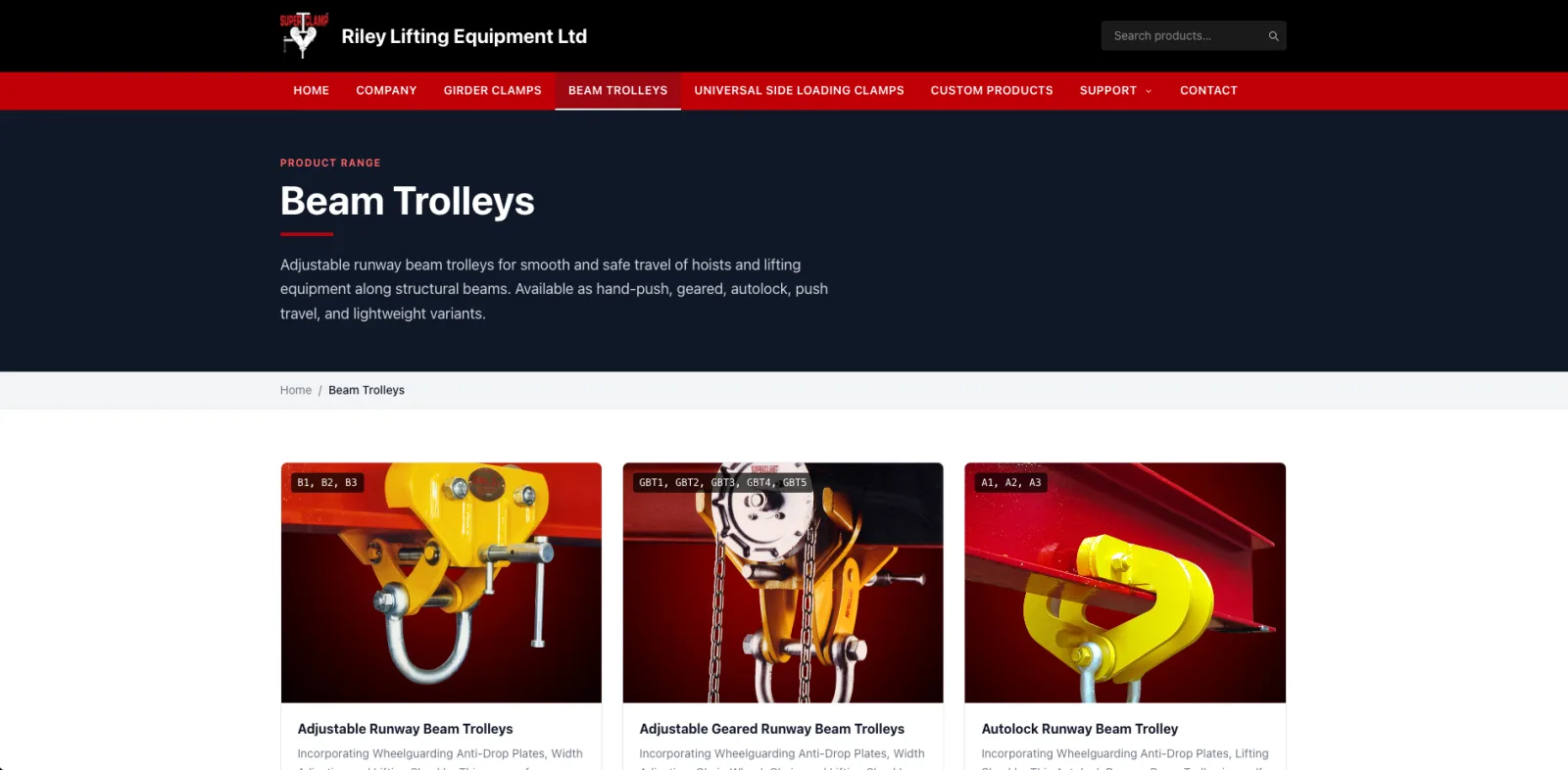
Superclamp, Riley (Lifting Equipment) Ltd's industrial lifting-equipment brand, gets a searchable catalogue with live model-number search and spec sheets. Built for engineers worldwide, it pairs range pages and a technical library of 90+ assembly drawings with an enquiry-led route to the team, built to be found by brand and by model.
Insullite CRM
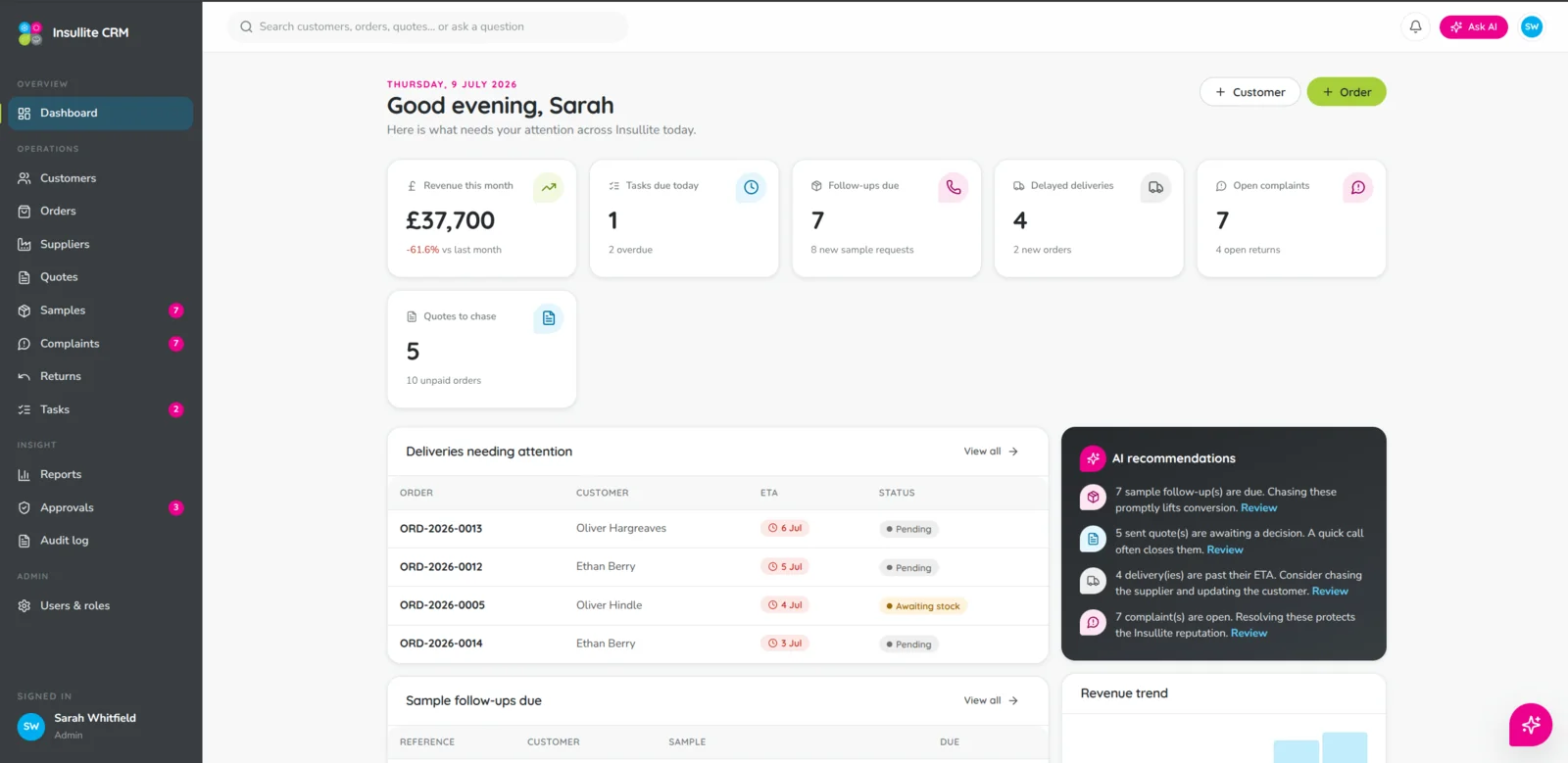
An internal operations platform for Insullite Ltd that pulls every brand, from Roofin to Buildin Stores to Plumin, and their back-office systems into one hub, with a permission-aware AI assistant that handles the busywork. Briefed, built and delivered in 24 hours.
Ready for a site that industrial buyers trust?
A £100 deposit secures your build. First preview within 72 hours, and you only pay the balance once you have approved the finished site.