
Websites for restaurants, bars and hospitality venues
Varsuite builds websites and AI-powered marketing for restaurants, bars, cafes and venues across the UK, including a 2 AA Rosette restaurant and a busy community venue. Built fast with AI, finished by a real UK team, priced for hospitality margins.
How diners decide where to eat
The decision to eat at your restaurant is usually made on a phone, often within a few minutes, frequently while the person is hungry. That context should shape every choice about your website. Diners are not browsing; they are checking. Can I see the menu? What does it cost? Are they open tonight? Can I book? Where do I park? Each unanswered question is a reason to tap back and choose somewhere that answers it.
Discovery has also changed shape. Some guests find you through search and maps, some through social media where a plate of food travelled further than any advert, and a growing number through AI assistants that summarise 'good places to eat near me' into a short, opinionated answer. You do not control which route a guest takes, but the same underlying asset serves all three: a website that states clearly what you serve, when you are open, what it costs and how to book, in a form both people and machines can read.
There is a second audience that hospitality sites often forget: the planner. The person organising a birthday, a wake, a Christmas party or a wedding reception researches differently. They compare venues, they look for private hire details and sample menus, and they make contact by form rather than phone. We built the site for The Hub Buckshaw, a hospitality venue, with exactly this dual audience in mind, and the same thinking runs through every hospitality website we build. Getting found by both audiences, the hungry and the planning, is what our SEO and AIO automation service exists for.
Reviews thread through every one of those journeys. Guests rarely read them like judges; they scan for patterns, and they weigh how a venue responds to the bad ones more heavily than the bad ones themselves. Your website cannot control what is said elsewhere, but it can be the place where the full picture lives: the current menu rather than the one photographed three years ago, the real opening hours, the honest description of what the place is. Venues lose more covers to out-of-date information than to criticism, and out-of-date information is the one problem entirely within your gift to fix.
What a hospitality website must do
A hospitality website earns its keep by removing friction between appetite and booking. The essentials are unglamorous and non-negotiable.
- The menu as real text. Not a PDF that hijacks the phone screen, not a photograph of a printed page. Text menus load fast, resize properly, can be updated in minutes and, crucially, can be read by search engines and AI assistants, which quote them when someone asks what kind of food you serve.
- Hours and contact without hunting. Opening times, address, phone and directions visible within one scroll, and marked up with structured data so maps and answer engines show them correctly.
- Booking with the fewest possible taps. Whether you take bookings by system, form or phone, the route should be obvious on every page.
- Photography that sells the experience. Food, room and atmosphere. This is the one place where hospitality genuinely differs from other industries: people are buying a feeling, and the pictures carry it.
- Events and private hire. A proper page for functions with capacities and enquiry forms, because one booked function can be worth a full evening of covers.
Speed underneath it all: a slow site on mobile data loses the walk-by guest standing outside comparing you with the place next door. Our builds are tested on real phone conditions and signed off by a person before launch.
A brochure site at £500 plus £100 a month fits most independent venues, and the monthly plan matters more in hospitality than almost anywhere else: menus change, hours change seasonally, events come and go, and unlimited content changes within fair use mean none of that ever sits in a developer's queue or generates an invoice. See the pricing page for the full picture, and our restaurant and venue work for how it looks in practice.
Bookings, vouchers and the systems behind the front of house
Most venues accumulate a small tangle of systems: a booking platform, a card machine and till, a gift voucher arrangement, social accounts, maybe a delivery partner. The website has to sit at the centre of that tangle gracefully, sending guests to the right system without making them feel passed around.
We are deliberately unopinionated about which booking system you use. If you already run one that works, we integrate the site with it cleanly: booking buttons where guests expect them, the widget or handoff styled so it does not feel like leaving your brand. If your current arrangement is a paper diary and a phone that rings during service, we can build enquiry and booking flows on the site itself that capture the details properly. Where deeper connections are worth it, our data integrations work joins the pieces, scoped and quoted after we see what you actually run rather than sold as a one-size connector.
Vouchers deserve particular attention because they are close to pure margin and spike at Christmas. Selling them online, through an online store arrangement from £1,000, turns gift demand into revenue that arrives while the kitchen is closed, rather than depending on someone phoning up during service to buy one.
Beyond guest-facing systems, hospitality businesses carry real back-office weight: supplier orders, rotas, function sheets, the spreadsheet that only the manager understands. Our business systems and business automation work replaces the fragile parts with software shaped to how your venue actually operates, from £1,000, scoped after a proper conversation. The aim across all of it is the same: fewer systems fighting each other, fewer things retyped, and a front of house that spends service looking after guests rather than administrating them.
Delivery and click-and-collect deserve a deliberate decision rather than a drift. If third-party platforms bring you orders, the arithmetic of their commissions changes at volume, and a venue with regular direct customers can shift a meaningful share of that trade through its own site instead. That is not the right move for every kitchen, and we will say so when it is not, but it should be a choice made with the numbers in front of you rather than a default inherited from lockdown. Either way, the website remains the one channel where the margin is entirely yours.
Being the answer when someone asks where to eat
Ask an AI assistant for somewhere good to eat in your town and you will get a short list with reasons: this one for the tasting menu, that one for families, this one for a Sunday roast. Those answers are assembled from what machines can read about you, and most restaurant websites give them almost nothing to work with: menus locked in PDFs, hours buried in an image, no structured data, no page that plainly says what the restaurant is and does well.
This is answer engine optimisation, and hospitality is one of the sectors where it bites earliest, because eating out is exactly the kind of question people now ask assistants. The fix is mostly disciplined clarity: menus as readable text, a page per audience (dining, drinks, functions, Sunday lunch, whatever your patterns are), plain statements of what you serve and who it suits, structured data for hours, location, menus and reviews, all kept current. Our SEO and AIO automation service handles this as an ongoing discipline rather than a one-off audit, because the venues that stay quotable are the ones whose information stays fresh.
Traditional local search still matters alongside it. The searches that fill tables, your cuisine plus your town, dog friendly, private dining, near the station, reward venues with pages that actually address them. Our AI content and blogging service, from £100 a month, publishes that material steadily: seasonal menu features, event announcements, guides to what is on locally, each reviewed before it goes out. And with marketing reporting you see, in plain English, what was published and what came of it. We built the site for Riverside Bar and Kitchen, a 2 AA Rosette restaurant, on exactly this principle: food of that standard deserves to be found.
Social media and content without losing your evenings
Hospitality runs on social media more than almost any other trade, and it is also the industry least able to resource it. The person who should be posting is running a service. So the account goes quiet for three weeks, then someone posts four things in a night, then it goes quiet again. Everyone knows consistency is what works; nobody has the hours to be consistent.
This is precisely the shape of problem automation is good at. Our social media management service keeps your channels active on a steady rhythm: menu highlights, events, offers, the seasonal drumbeat that keeps you in feeds and in minds, with content produced by AI and reviewed before it publishes. Paired with AI copywriting for the words and the blog engine behind AI content and blogging, the whole content layer runs from £100 a month, which is a fraction of what an agency retainer or a part-time marketer costs, and it does not call in sick on the Friday of a bank holiday weekend.
Two honest notes. First, automation here is opt-in and controllable: automated features are off until you switch them on, you can keep every post on manual review if you prefer to approve before anything publishes, and your portal includes an emergency stop. Plenty of venues start on manual review and loosen the reins once they trust the output. Second, AI does not know your specials board changed at 4pm unless the process includes you, so we design the workflow around how your kitchen actually communicates.
For venues that want to push specific occasions, Mother's Day, Christmas parties, a new menu launch, we also run Google Ads management with proper reporting, so promotion is a decision rather than a hope. The point of all of it is simple: your marketing keeps moving while you run the venue.
The other half of consistency is the mundane detail guests actually check: keeping hours, menus and offers matched across your site and your profiles, so the answer a guest finds at 5pm on a Sunday is true. Automation is good at exactly this kind of faithful repetition, and it is where small venues quietly beat bigger ones, because a chain's information goes stale at the speed of head office.
Proof, pricing and how the build works
Hospitality margins do not leave room for vanity projects, so here is the arithmetic straight. A brochure website is £500 plus £100 a month. The monthly fee covers hosting, security monitoring and unlimited content and design changes within fair and reasonable use, which in venue terms means menu updates, seasonal hours, new photography and event pages are simply part of the service. Automated content marketing runs from £100 a month. Bigger pieces, voucher stores, booking flows, custom systems, start from £1,000 and are quoted after we understand what you need. Everything is published on the pricing page.
The build process is designed for people who cannot spare a week of meetings. A £100 deposit secures your build. You tell us about the venue, send over menus, photography and whatever brand you have, and our AI agents produce the design and build with a UK team steering the detail. First preview within 72 hours. You review the finished site, and only when you approve it do the balance and hosting become due. If service runs late and you look at the preview at midnight, that is fine; it will still be there.
Proof is on the work page. Riverside Bar and Kitchen is a 2 AA Rosette restaurant whose site we built; The Hub Buckshaw is a hospitality venue with a broader mix of audiences. Different venues, same standard: built quickly, finished properly, looked after once live.
After launch, our management service means the site is monitored around the clock and there is a UK team to contact when you need a change, one that already knows your venue. If your current site is a PDF menu behind a slow homepage, get in touch; the fix costs less than most venues expect.
Common questions
A brochure website is £500 plus £100 a month, covering hosting, security monitoring and unlimited content and design changes within fair use, which includes menu updates, seasonal hours and event pages. A £100 deposit secures the build, you see a first preview within 72 hours, and the balance is only due after you approve the finished site.
Yes. If you already use a booking system we integrate the site with it cleanly, and if you take bookings by phone or email we build enquiry and booking forms that capture the details properly. Deeper integrations with your existing systems are scoped and quoted after we see what you run.
No. PDF menus are slow on phones, awkward to update and invisible to the search engines and AI assistants that increasingly answer 'where should I eat' questions. We build menus as real text with structured data, so they load fast, update in minutes under your monthly plan, and can be read and quoted by machines as well as people.
Yes. Our automated content marketing runs from £100 a month: social posts, blog content and SEO and AIO work produced by AI and reviewed before publishing. Automation is opt-in, you can keep every post on manual approval if you prefer, and marketing reporting shows you in plain English what was published and what it achieved.
Work that backs this up
Real builds for real businesses in and around this industry, each one a published case study.
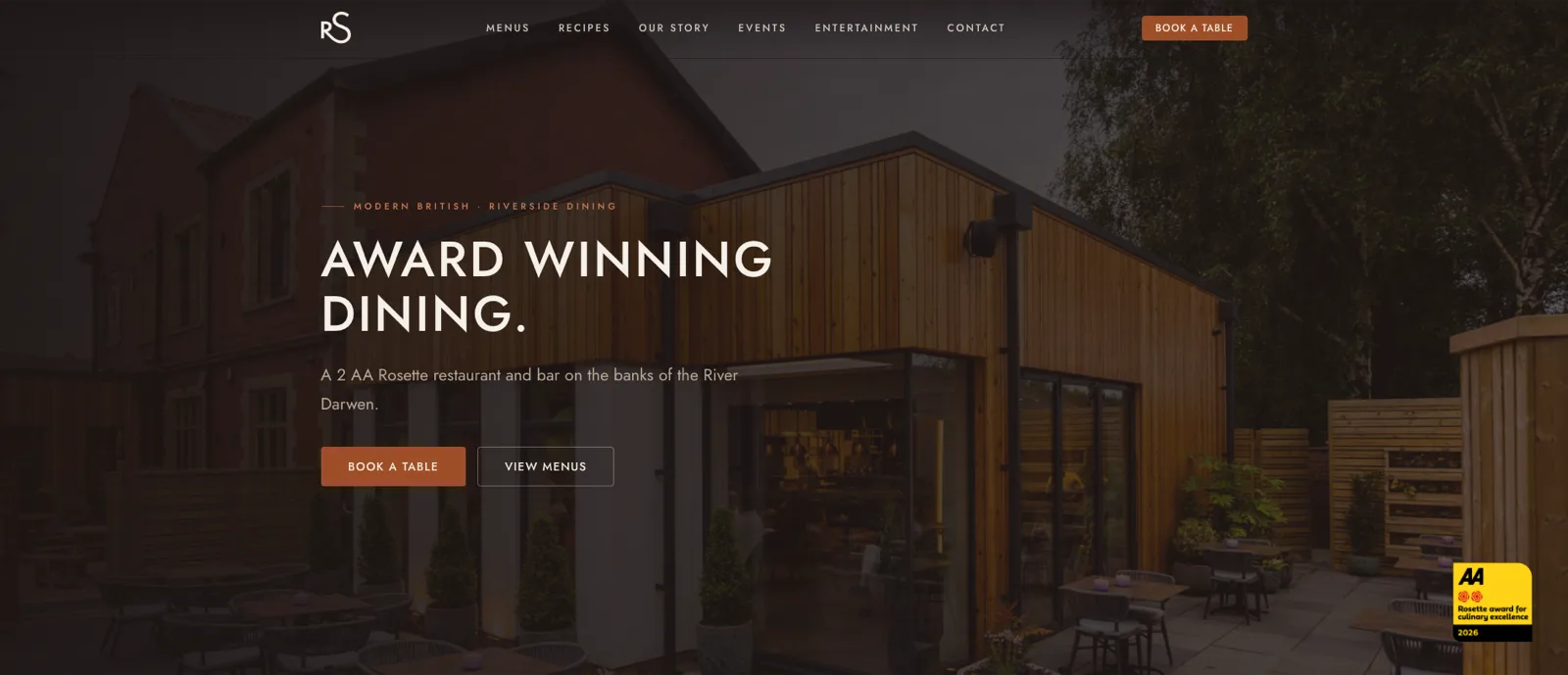
The Riverside Bar & Kitchen
A brand-new Laravel website for The Riverside Bar & Kitchen, a 2 AA Rosette modern British restaurant on the banks of the River Darwen in Lower Darwen, Blackburn. Built around their new brand, with live menus, the story, events and entertainment, and a Book a Table flow.
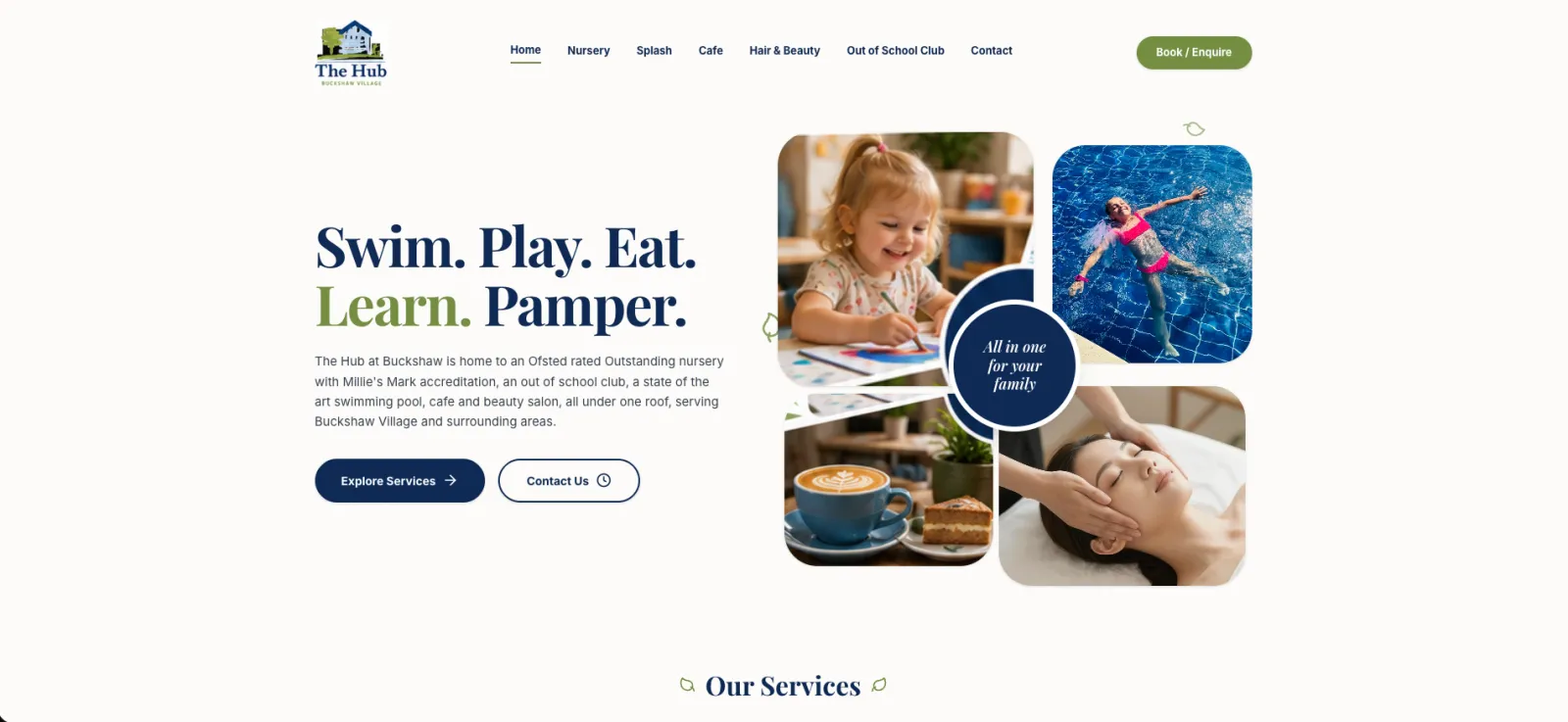
The Hub at Buckshaw
A full Laravel rebuild of the marketing site for The Hub at Buckshaw, an all-in-one family destination in Buckshaw Village, Chorley. Five very different services under one roof, each given its own space inside one fast, accessible, SEO and AEO optimised brand.
Ready for a site that fills tables?
A £100 deposit secures your build. First preview within 72 hours, and you only pay the balance once you have approved the finished site.