
Websites and online stores for retail and e-commerce
Varsuite builds online stores for retailers across the UK, from industrial equipment to luxury rental. Stores from £1,000 with product import, payment gateways, a sales dashboard and a daily AI content engine, built fast and checked by a real UK team.
How people actually buy online now
Online buying has compressed. The modern shopper compares more and tolerates less: price checked across tabs in seconds, delivery cost and speed weighed before commitment, reviews skimmed for the one-star patterns, and the whole judgement made on a phone, frequently in the moments between other things. A store wins or loses on small frictions. A product page that takes four seconds to load has lost a proportion of its visitors before it drew. A checkout that demands account creation, or springs delivery costs at the last step, converts browsers into abandoned baskets with industrial efficiency.
Discovery has changed as much as decision. Search still matters, but it now shares the journey with AI assistants that answer 'what should I buy for X' questions directly, recommending specific products and retailers, and with social platforms where products travel as content. The stores that surface in those AI answers are the ones whose product information is complete, structured and readable by machines: clear names, honest descriptions, prices, availability and policies stated where they can be found. Retailers who treat product data as an afterthought are invisible in the fastest-growing discovery channel there is.
Trust remains the quiet decider, especially for smaller retailers competing with the giants. Clear returns policies, visible contact details, honest stock information and a site that simply feels maintained: these are the signals that let an independent charge fairly and still convert. Returns behaviour completes the picture: modern shoppers treat the returns policy as part of the price, unclear terms read as risk, and risk needs a discount to overcome, while a plainly stated policy lets you hold price instead. The same goes for delivery promises, where a slightly slower date kept is worth more than a faster one missed, because repeat custom, not the first order, is where independent retail margin actually lives.
It is all buildable, and it is what our online store builds are structured around, with the visibility layer maintained by SEO and AIO automation. The range of what that looks like in practice runs from Superclamp, industrial lifting equipment sold to trade buyers, to Lafeef, a luxury rental e-commerce build: very different shops, identical fundamentals.
What your store must do to convert
Conversion is not a trick; it is the accumulation of removed obstacles. These are the ones that matter most, and the ones we build for.
- Speed as a discipline. Fast on mobile data, not just on the office wifi. Every second of load time taxes every visitor, and speed also feeds search rankings, so it pays twice.
- Product pages that finish the job. Complete descriptions, honest photography, sizes, specifications, availability and delivery expectations answered on the page. A question the page does not answer becomes a tab-switch to a competitor who does.
- Search and navigation that match how customers think. Categories built around buyer intent rather than your stockroom layout, search that survives typos, filters that reflect the decisions people actually make.
- A checkout with nothing in the way. Guest checkout, the payment methods your customers expect, delivery costs visible early, and as few fields as the order genuinely needs.
- Trust signals placed where doubt occurs. Returns policy near the buy button, contact details a human can actually use, reviews where they influence rather than decorate.
Every Varsuite store is exercised by test agents and signed off by a person before handover: checkout flows, payment paths, stock behaviour and the unglamorous edge cases, because a store's bugs cost money in the most direct way software bugs can. Our testing and QA discipline exists precisely because retail cannot afford launch-day surprises.
Stores start at £1,000 plus £150 a month, and the pricing page sets out exactly what that includes. For retailers weighing a first store against upgrading a tired one, the wider cost context in our guide to what a website costs in the UK is a useful, straight read.
None of these fundamentals is visible in a design mockup, which is why store projects judged only on how the homepage looks so often trade below their potential. Judge a store the way your customers will: on a phone, in a hurry, with a card in the other hand.
What the £1,000 store build actually includes
Store pricing in this industry is notoriously foggy, so here is ours in the open. An online store from Varsuite starts at £1,000 as a one-off build, plus £150 a month, and the plan is built to be a trading platform rather than a shell.
The build includes importing your product range, which is routinely the most underestimated part of any store project: products, variants, images, prices and categories brought across and structured properly, rather than left as an exercise for the exhausted owner. Payment gateways are connected as part of the build, so you can take the payment methods your customers expect from day one. And the store comes with a sales dashboard, so what is selling, and what is not, is visible at a glance instead of buried in exports.
The £150 a month is where the model differs most from the market. It covers hosting and care, security monitoring, and unlimited content and design changes within fair and reasonable use, so seasonal reworks, new ranges and category restructures are maintenance rather than invoiced projects. It also includes a daily AI-written blog with SEO and AIO optimisation: a content engine that publishes material around your products, categories and customers' questions every day, reviewed before it goes out, giving search engines and AI assistants a constant stream of reasons to surface your store. Most independent retailers cannot resource a single post a week by hand; the plan ships one a day.
Commercially, the risk structure is the same as everything we build: a £100 deposit secures the build, a first preview arrives within 72 hours, and the balance is due only after you have reviewed and approved the finished store. Larger and more complex retail builds, trade pricing, unusual product models, heavy integrations, start from the same £1,000 floor and are scoped honestly after we understand the requirement, as our custom software work. The full detail sits on the pricing page.
Integrations: stock, accounts and everything behind the checkout
A store's website is the visible third of a retail operation. Behind it sit stock control, accounting, dispatch, supplier ordering and customer service, and the difference between a store that scales and one that consumes its owner is whether those pieces are connected or manually bridged. Every gap between systems is a person retyping: orders keyed into the accounts package, stock adjusted in two places, dispatch details copied into a courier portal, and every retype is an error waiting for a busy Friday.
Our data integrations work closes those gaps around whatever you already run. Orders flowing into the systems that fulfil and account for them. Stock mastered in one place and reflected on the site, so the website stops selling what the stockroom does not have. Customer and order history visible where customer service actually happens. Integrations are scoped and quoted after we see your real setup, because retail stacks are personal: the answer for a boutique with three hundred lines is not the answer for a trade supplier with thirty thousand.
Where the operation needs more than connections, our business systems and custom CRM work builds the missing pieces around how you actually trade: trade account management, quotation workflows for B2B customers, repeat-order tooling, the internal admin that off-the-shelf platforms handle generically or not at all. And where a process is still a spreadsheet ritual, process replacement turns it into software. Insullite CRM, an internal CRM platform on our work page, shows that internal-build capability directly.
The pattern across successful retail clients is consistent: the website earns attention, but the integrations earn margin, because they convert hours of admin into background automation. Custom work starts from £1,000, scoped after a proper look, and we are candid at scoping about which connections will pay for themselves and which are engineering for its own sake.
Customer service is the integration retailers forget until it hurts. When order status, delivery information and history are visible in one place, the 'where is my order' messages that consume retail inboxes get answered in seconds, and the customer's experience of a problem becomes the reason they come back rather than the reason they left. Service is a system too, and it deserves the same plumbing as stock and accounts; it is also the cheapest loyalty programme you will ever run.
Marketing the store after launch
Launching a store and expecting customers to arrive is the most expensive misunderstanding in e-commerce. A store is a market stall: location and footfall are everything, and both are earned continuously. The retailers who win treat marketing as a system that runs weekly, not a campaign that happened once, and systems that must run continuously are exactly what automation is for.
The foundation is the content engine included with the store plan: a daily AI-written blog with SEO and AIO optimisation, publishing material around your products, categories and the questions your customers actually ask. Daily publication does two compounding things: it builds the long-tail search visibility that product pages alone never achieve, and it keeps your store readable and quotable by the AI assistants that increasingly answer shopping questions directly. On top of it, AI copywriting sharpens product descriptions and campaign copy, and social media management keeps your channels moving with the same rhythm the blog gives your site.
Paid traffic has its place, run with discipline. Our Google Ads management service handles shopping and search campaigns with the boring virtues that make ads pay: proper structure, continuous adjustment and honest measurement. And measurement is where everything joins up: marketing reporting tells you in plain English what was published and spent, what it brought in, and what to do next, replacing the dashboard fog that lets underperforming spend hide for months.
All of the content automation carries the same controls as everywhere else at Varsuite: opt-in, reviewable before publishing, reversible, with an emergency stop in your portal. And it carries the same honesty: nobody can guarantee rankings or ad performance, and we do not. What automation guarantees is the thing manual marketing never delivers for an independent retailer: consistency, at a cost that starts from £100 a month for content marketing alongside the store plan. The pricing page shows how the pieces combine.
Proof: stores we have built, and how yours would start
Retail is a show-me business, so we will show you. Superclamp is an industrial lifting equipment business in Colne selling a technical range to trade buyers through a store we designed and built. Lafeef is a luxury rental e-commerce build, a very different commercial model with very different presentation demands. Plumin Online sells plumbing supplies, and Recycled Software is an e-commerce business whose store we built. Four different markets, price points and buyer psychologies, delivered by the same team with the same fundamentals: fast, structured, trustworthy and maintained. The full set is on the work page.
Starting yours follows the process every Varsuite build uses, tuned for the realities of trading. A £100 deposit secures the build. We take your brief, your product data and your brand; our AI agents produce the design and build while a UK team steers the detail; and you see a first preview within 72 hours. You review the finished store, click through it as your own customer would, and only when you approve it do the balance and hosting become due. If you are migrating from an existing store, product import is part of the build, and we plan the switchover so trading continues.
After launch, the store is monitored around the clock, security monitoring watches what is live, and our management service means a real UK team handles changes on request, with the daily content engine publishing throughout. Our always improving approach treats the store as a trading asset that develops: what the dashboard and reporting reveal feeds what gets refined next.
If your products deserve better than the store currently selling them, or you are ready to sell online for the first time, tell us what you sell. You will get a straight plan, a published price and a preview before the balance, which is how buying software should feel.
Common questions
Stores start at £1,000 as a one-off build plus £150 a month. The build includes product import, payment gateway connection and a sales dashboard, and the monthly plan covers hosting, security monitoring, unlimited content and design changes within fair use, and a daily AI-written blog with SEO and AIO optimisation. A £100 deposit secures the build and you approve a preview before paying the balance.
Yes, product import is included in the store build: products, variants, images, prices and categories brought across and structured properly rather than left for you to re-enter. If you are switching from a live store, we plan the changeover so you keep trading through it.
The store includes a sales dashboard showing what is selling, and our marketing reporting service translates activity into plain English: what was published, what it reached and what it brought in. We do not guarantee rankings or ad results, and we would be wary of anyone who does, but you will always be able to see what is happening and why.
That is our data integrations work: orders flowing into your accounts and fulfilment systems, stock mastered in one place and reflected on the site, and customer history visible where service happens. Integrations are scoped and quoted after we see your actual setup, and we are honest about which connections will pay for themselves.
Work that backs this up
Real builds for real businesses in and around this industry, each one a published case study.

Lafeef
Lafeef, a luxury furniture and decor rental house in Riyadh, gets a bilingual English and Arabic site over a catalogue of more than 1,100 pieces. Piece counts, specifications and a quote basket in place of a checkout, built for the event planners working across Saudi Arabia and the Gulf.
Superclamp
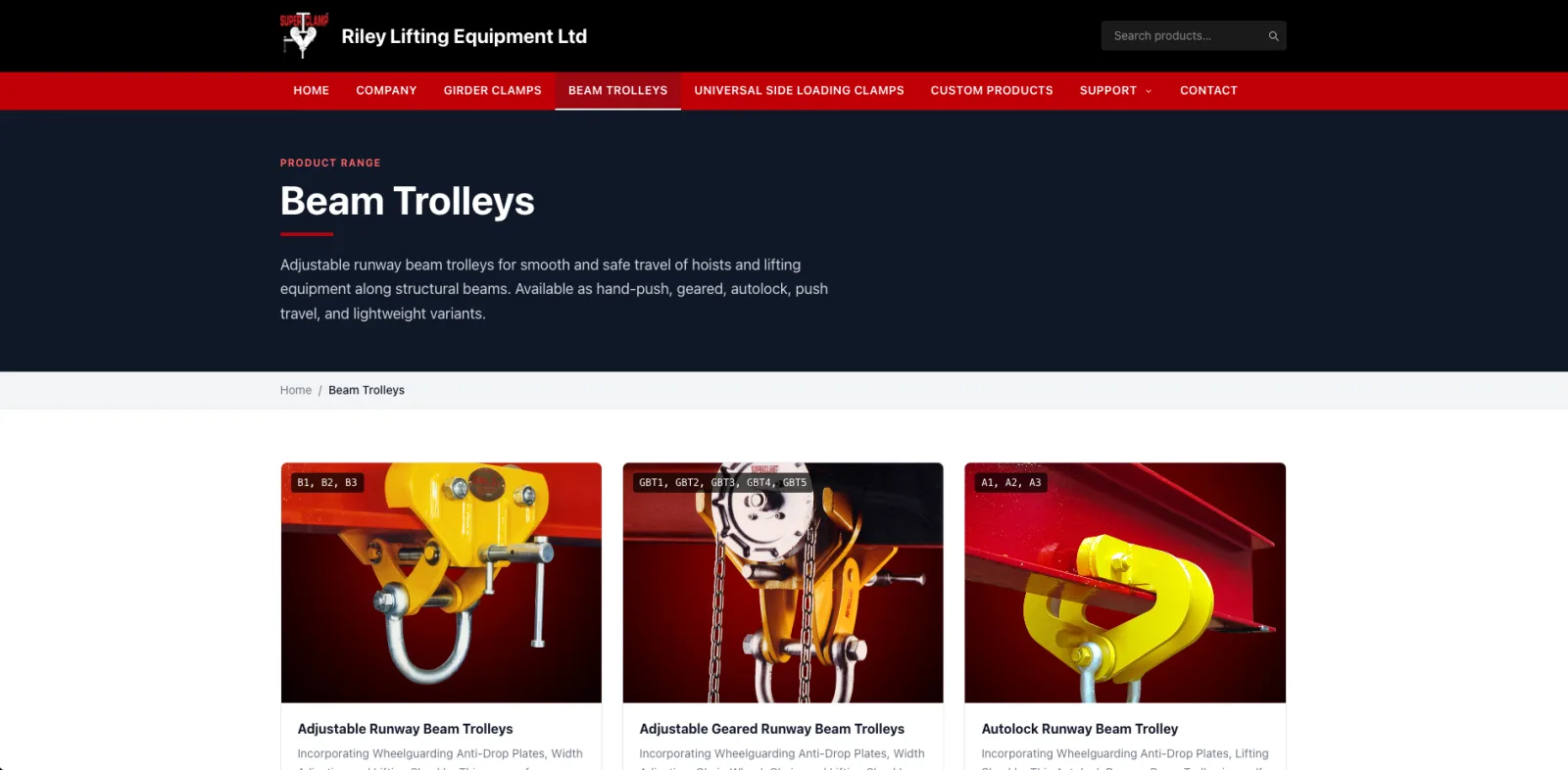
Superclamp, Riley (Lifting Equipment) Ltd's industrial lifting-equipment brand, gets a searchable catalogue with live model-number search and spec sheets. Built for engineers worldwide, it pairs range pages and a technical library of 90+ assembly drawings with an enquiry-led route to the team, built to be found by brand and by model.
Plumin Online
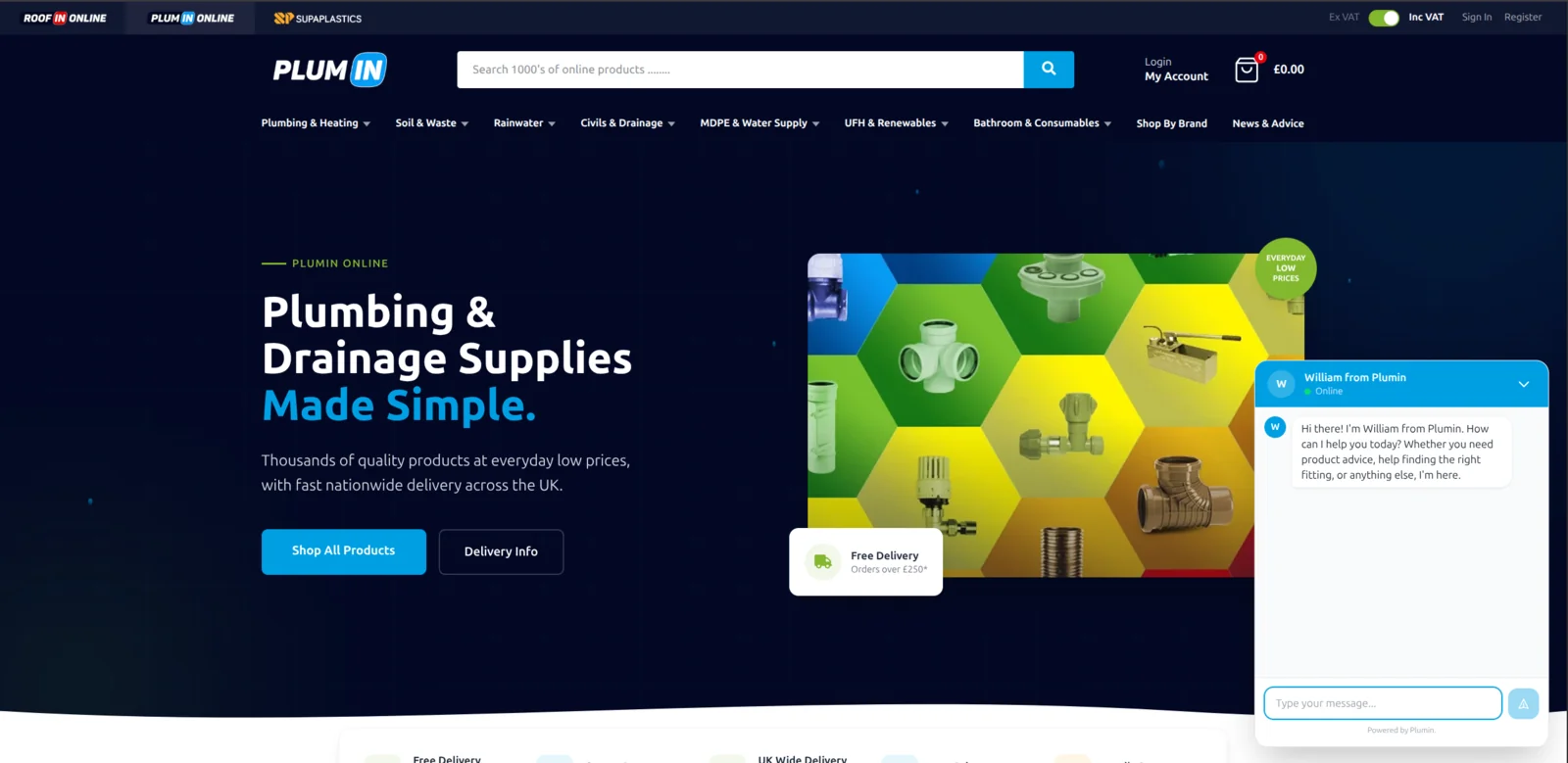
A full custom-built e-commerce store for Plumin Online, the plumbing and drainage supplies brand, on Laravel, with a modern custom admin back office and an AI shopping assistant that helps trade and DIY buyers find exactly the right part. Briefed, built and delivered in 24 hours.

Recycled Software
A modern e-commerce store for Recycled Software, selling genuine pre-owned Microsoft licences with instant digital delivery, a full self-service account area, and an AI support agent that answers grounded in each customer's own orders.
Ready to sell more online?
A £100 deposit secures your build. First preview within 72 hours, and you only pay the balance once you have approved the finished store.